A practical guide for K–5 parents
How to increase your child’s chances of getting into an advanced learning program
Start with your school district’s actual rules. Find out how students are referred, which assessments are used, when testing happens, and whether the district considers grades, teacher input, portfolios, or other evidence. If CogAT is part of the process, build familiarity with its question formats through short, calm reasoning practice.
No test-prep app can guarantee a score or program placement. The useful goal is a child who understands the task, can show their reasoning, and arrives rested rather than anxious.
Free practice questions each day
01 / Know the process
Advanced learning identification starts locally
Schools may call these services gifted and talented, advanced academics, highly capable, or advanced learning. The name matters less than the eligibility rules. In the United States, identification policies commonly vary by district or school, and the CogAT may be one part of a broader process.
The National Association for Gifted Children recommends using multiple objective and subjective measures instead of letting one test decide everything. That can include ability or achievement scores, classroom performance, teacher observations, parent input, work samples, or portfolios. Ask for the current written policy rather than relying on what happened in a previous school year.
Ask your school these questions
- Is screening universal, teacher-referred, parent-requested, or a combination?
- Which grades are screened, and what are the referral and testing dates?
- Does the school use the full CogAT, a screening form, another assessment, or several measures?
- Are battery scores reviewed separately, or is a composite score used?
- How are classroom evidence, achievement, creativity, language background, disability, and local norms considered?
- What accommodations, appeals, retesting rules, and parent information are available?
Read more from the National Association for Gifted Children on assessments and identification.
02 / Understand CogAT
What the CogAT is designed to measure
CogAT stands for Cognitive Abilities Test. Its publisher, Riverside Insights, describes it as a measure of learned reasoning abilities rather than a traditional achievement test of mastered school content. The assessment uses three batteries:
Verbal
Reasoning with words, analogies, sentence relationships, and classification.
Quantitative
Reasoning with numbers, patterns, equations, and relationships.
Nonverbal
Reasoning with pictures, shapes, matrices, spatial relationships, and figures.
For the lower CogAT levels commonly used from kindergarten through second grade, most questions are pictorial and do not require reading; an optional sentence-completion subtest is an exception. The form, level, timing, and score rules your child encounters depend on the school’s testing plan, so confirm those details with the school.
See the publisher’s CogAT assessment structure and CogAT overview.
03 / Make a practice plan
Use practice to build familiarity, not pressure
A useful preparation plan helps your child recognize what a question is asking and explain a pattern or relationship. It should not crowd out school, play, sleep, or family time. Ten to fifteen focused minutes is often easier for an elementary-age child to sustain than a long drill session.
- Learn the formats first
Begin without a timer. Let your child describe what changes, what stays the same, and why one answer fits better than the others.
- Rotate the three batteries
Mix verbal, quantitative, and nonverbal work across the week. A balanced routine makes strengths and weaker areas easier to notice.
- Review mistakes calmly
Ask for the child’s thinking before explaining. Revisit a missed pattern later with a fresh example instead of repeating it until frustration builds.
- Practice test behavior
Work on listening to directions, checking every answer choice, moving on when stuck, and returning attention to the next question.
- Taper before test day
Use light review near the test date. Keep bedtime, breakfast, medication, glasses, and the morning routine as normal as possible.
Practice with a clear next step
CogAT Test Prep turns the plan into short K–5 sessions
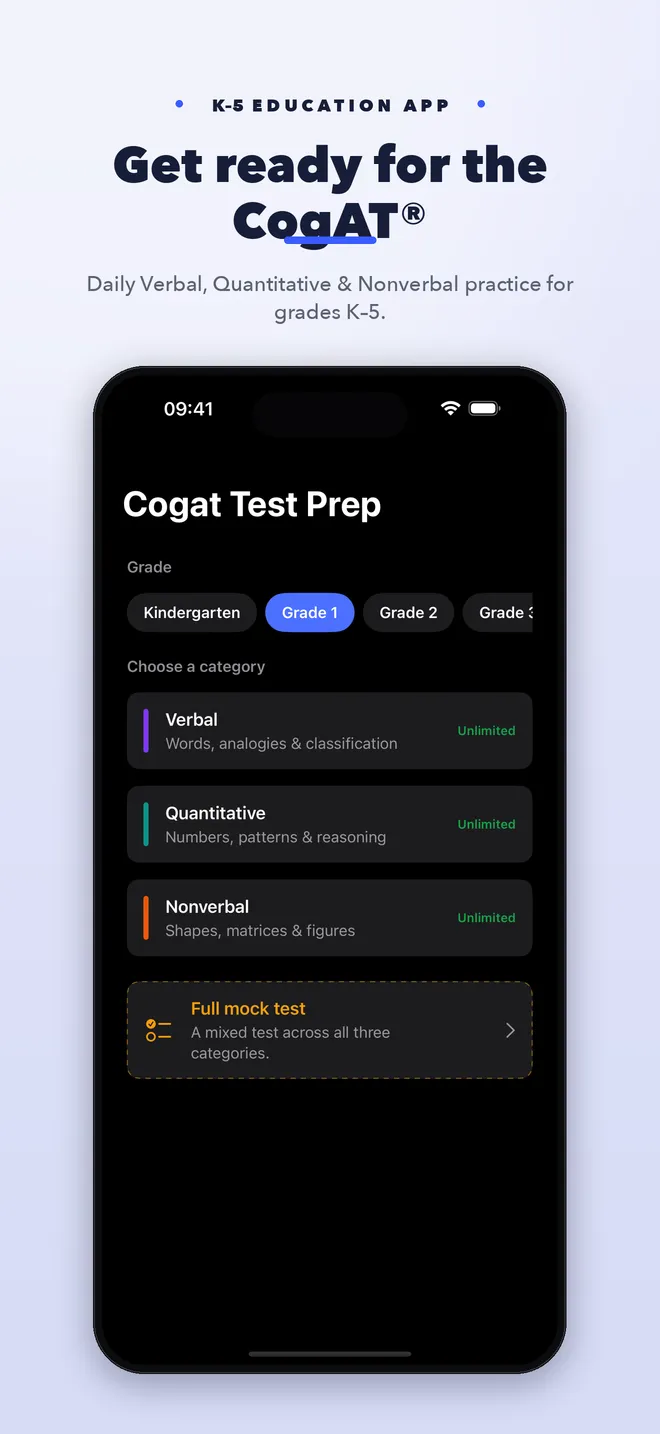
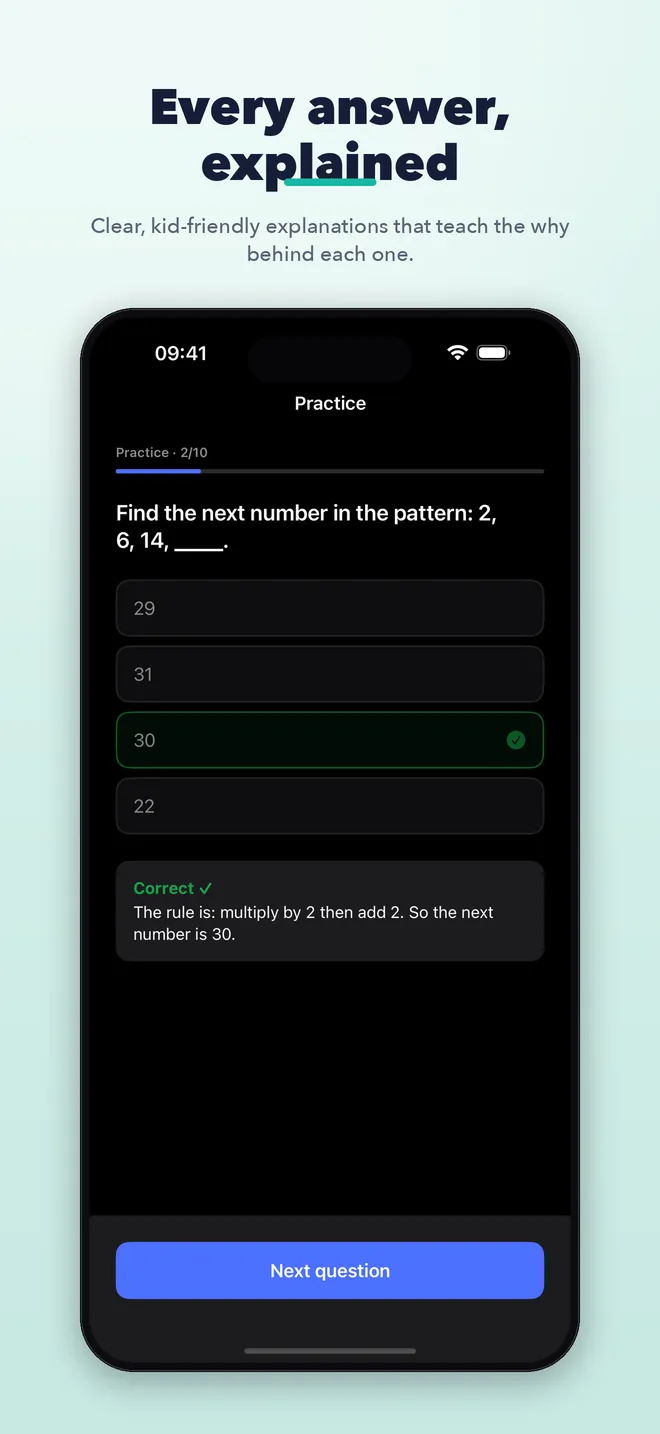
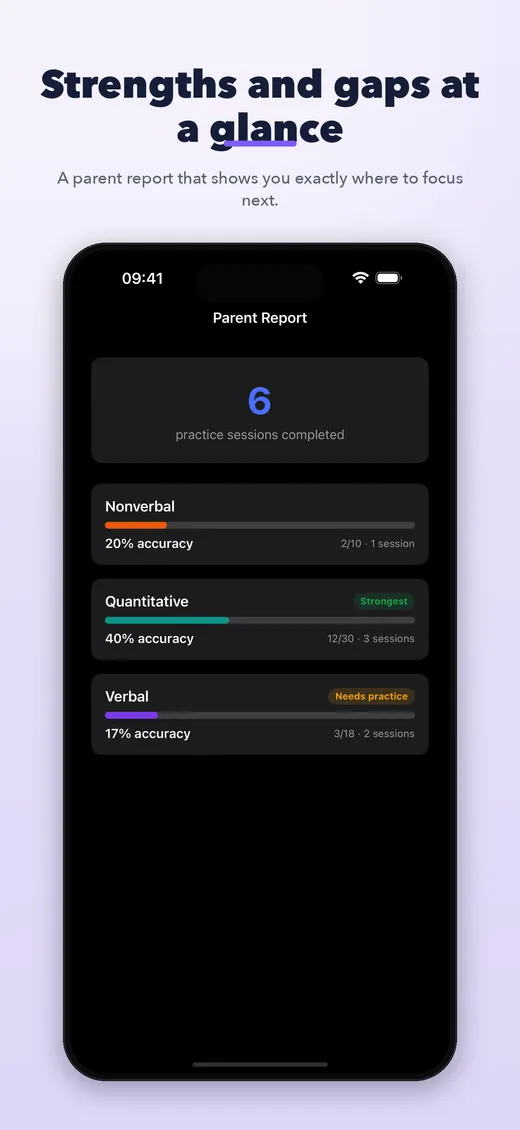
The app offers original grade-level practice in verbal, quantitative, and nonverbal reasoning. Each question includes a child-friendly explanation. Parents can use mock tests, the mistakes notebook, progress history, and category reports to decide what deserves attention next.
- Grades K–5
- English and Spanish
- Free practice questions each day
- No advertising inside the app
Free practice questions each day
04 / Parent questions
Advanced learning and CogAT FAQ
Does a high CogAT score guarantee advanced learning placement?
No. Districts set their own criteria, and many use several measures. Ask your school which scores and other evidence matter in its current process.
Can a child prepare for the CogAT?
A child can become familiar with reasoning-question formats, practice explaining patterns, and learn calm test habits. Preparation cannot guarantee a score, and practice questions should not copy secure test items.
How early should we start?
First learn the school’s dates. A few weeks of short, regular sessions usually creates a healthier routine than last-minute cramming. Stop or shorten a session when your child is tired or upset.
Does a kindergartner need to read for the CogAT?
At the lower CogAT levels used for kindergarten through second grade, most subtests use pictures and do not require reading. The optional sentence-completion subtest is an exception. Confirm the level and format with your school.
Is CogAT Test Prep the official CogAT app?
No. CogAT Test Prep is an independent preparation tool from Neobile LLC. It is not affiliated with, authorized by, or endorsed by Riverside Insights. All practice questions in the app are original.
CogAT® is a registered trademark of Riverside Insights. CogAT Test Prep is an independent product and does not guarantee admission to any gifted, talented, advanced academic, or advanced learning program.