A practical guide for K–5 educators
How to calculate WCPM and running record accuracy
For WCPM, subtract scored errors from words attempted, divide by elapsed seconds, then multiply by 60. For accuracy, divide correct words by words attempted and multiply by 100. Record self-corrections separately, and decide how insertions are handled before calculating.
Scoring conventions and benchmark expectations vary. Use the rules and published norms required by your school, district, curriculum, or assessment system.
Running record and oral reading fluency tools for educators
01 / Keep the math visible
The four running record and ORF formulas
Words correct
Words attempted − scored errors
WCPM
Correct words ÷ elapsed seconds × 60
Accuracy
Correct words ÷ words attempted × 100
Error ratio
Running words ÷ scored errors, written as 1:N
Self-correction ratio
(Scored errors + self-corrections) ÷ self-corrections, written as 1:N
If there are no scored errors, report the error ratio as unavailable instead of dividing by zero. Do the same for the self-correction ratio when there are no self-corrections.
02 / Work one example
Example: 100 words in 60 seconds with 5 errors
The student attempts 100 words in exactly one minute. Five words are scored as errors, so the student reads 95 words correctly.
Correct words100 − 5 = 95
WCPM95 ÷ 60 × 60 = 95
Accuracy95 ÷ 100 × 100 = 95%
Error ratio100 ÷ 5 = 1:20
If the same 95 correct words took 75 seconds, the calculation would be 95 ÷ 75 × 60 = 76 WCPM. Using the exact time avoids treating every sample as if it lasted exactly one minute.
03 / Do not blend the rules
ORF and running records may handle marks differently
Before calculating, identify the scoring convention required for the assessment. A small difference in how an insertion or self-correction is treated can change correct words, WCPM, accuracy, and ratios.
ORF / WCPM convention
- Teacher-marked errors reduce correct words.
- Insertions are recorded but do not count as errors.
- Successful self-corrections count as correct.
- WCPM is the primary fluency rate.
Running-record convention
- Teacher-marked errors reduce correct words.
- Insertions count as scored errors.
- Self-corrections feed the SC ratio.
- Accuracy and reading-level bands are commonly reviewed.
Published cutoffs are not universal. Some systems use different accuracy bands or benchmark expectations by grade and season. Keep the assessment name, raw counts, elapsed time, and convention with each result so another educator can understand how the score was produced.
04 / Make assessment time easier
A faster oral reading fluency workflow
- Prepare the authorized passage
Use a passage and directions from your school or assessment system. Confirm the stopping rule and the convention before the student begins.
- Time and mark consistently
Mark miscues as they happen, record self-corrections distinctly, and note insertions without losing your place in the text.
- Capture the exact stop point
Record words attempted and elapsed time. For a timed one-minute probe, identify the final word reached at the stop signal.
- Calculate and retain the inputs
Keep the raw words, errors, self-corrections, insertions, time, and convention beside the calculated scores.
- Interpret with the right source
Compare the result only with the benchmark or norm table specified for that assessment. Look across repeated measures rather than overreacting to one sample.
From marking to results
FluencyCalc keeps the timer, marks, and math together
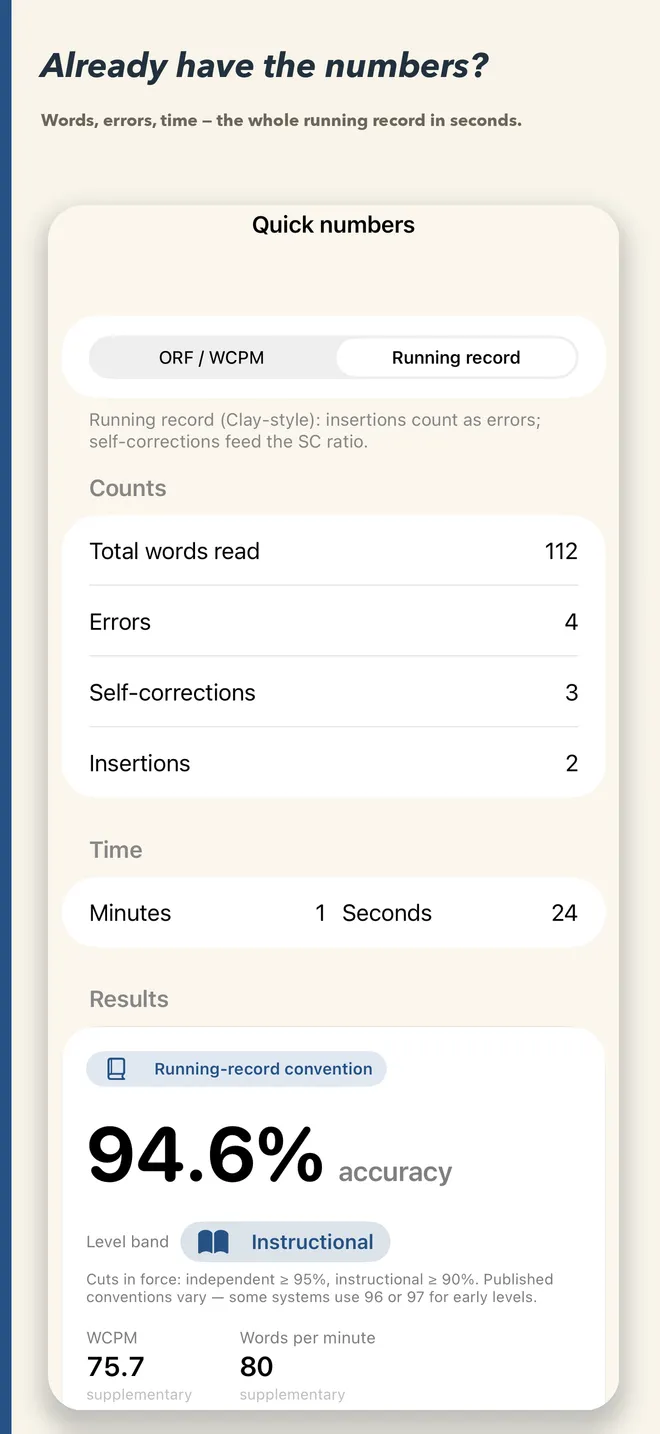
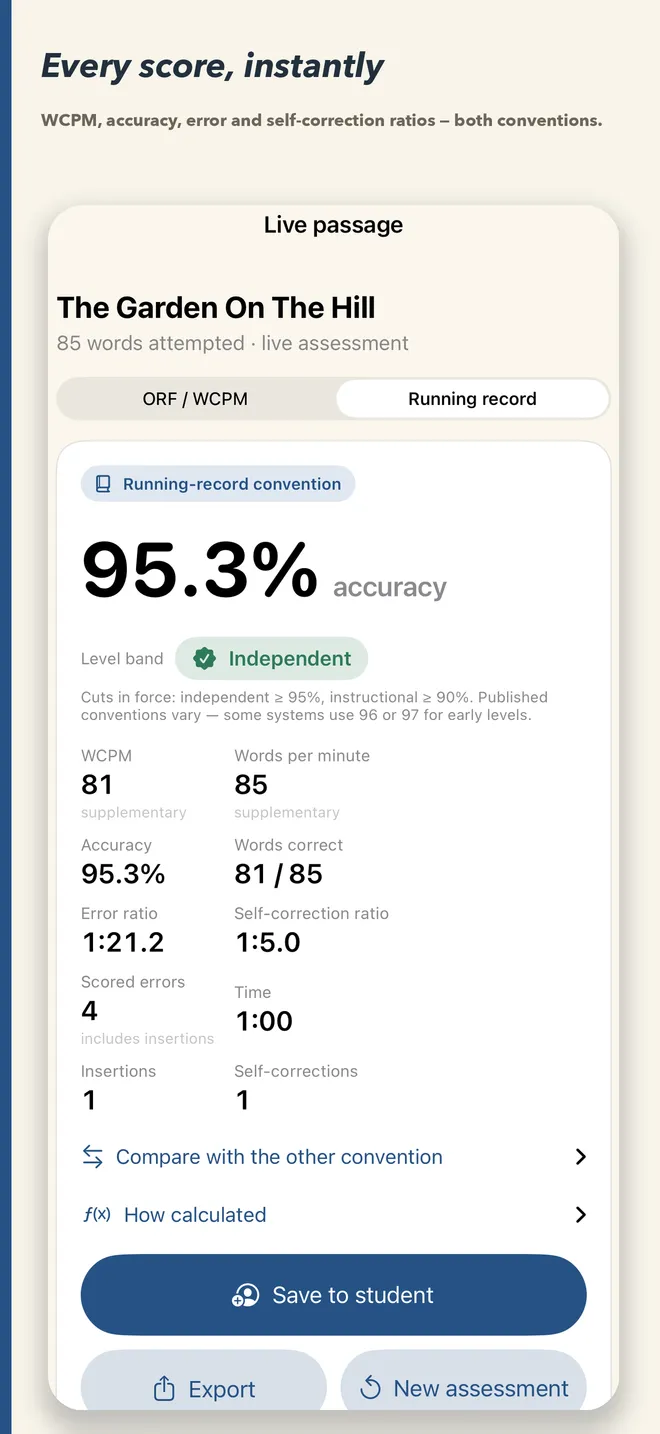
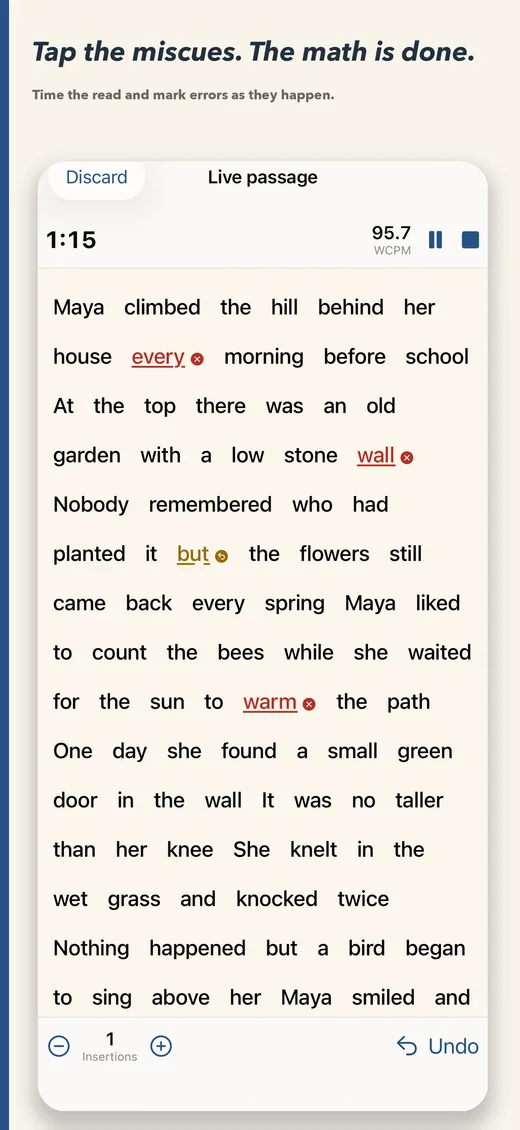
Paste or type a passage for live tap-marking, or enter the final counts in the quick calculator. FluencyCalc calculates WCPM, accuracy, error ratio, self-correction ratio, and related values while keeping ORF and running-record conventions clearly separated.
- Live passage marking
- Quick number entry
- Student growth charts
- PDF and CSV reports
Running record and oral reading fluency tools for educators
05 / Scoring questions
WCPM and running record FAQ
What is the formula for WCPM?
Subtract scored errors from words attempted, divide the correct words by elapsed seconds, and multiply by 60. For a one-minute sample, WCPM is simply words attempted minus scored errors.
How do I calculate running record accuracy?
Divide correct words by running words and multiply by 100. Under the running-record convention used here, insertions are added to scored errors before correct words and accuracy are calculated.
Do self-corrections count as errors?
In the conventions presented here, a successfully self-corrected word counts as correct. Self-corrections are still recorded for the self-correction ratio.
What happens when the reading lasts longer than one minute?
Use the exact elapsed time. Divide correct words by elapsed minutes, or divide by seconds and multiply by 60, to normalize the score to words correct per minute.
Does FluencyCalc include reading passages or national norms?
No. Educators bring materials they have the right to use and apply the benchmark or norm source required by their school or assessment system.
FluencyCalc computes scores from educator-marked responses. Interpretation belongs to the educator. The app contains no reading passages or published norm tables and makes no diagnosis or instructional prescription.