Restoration Drying Calc / field workflow
How to calculate GPP and document a drying job
Record the air readings and the material readings on each visit. Enter dry-bulb temperature and relative humidity in a psychrometric calculator to see GPP and dew point, then log dated moisture readings for the same room and measurement points over time.
Compare readings in context. A calculator and log support field judgment; they do not establish a dry standard for a material or job.
Offline field calculator and drying log
01 / Practical steps
Record the conditions you actually measured
Start a job record with its drying zones and rooms. At each monitoring visit, note where the reading was taken and which instrument supplied it. An air reading only makes sense with its temperature and humidity input, and a material reading is much more useful when you can find the same point tomorrow.
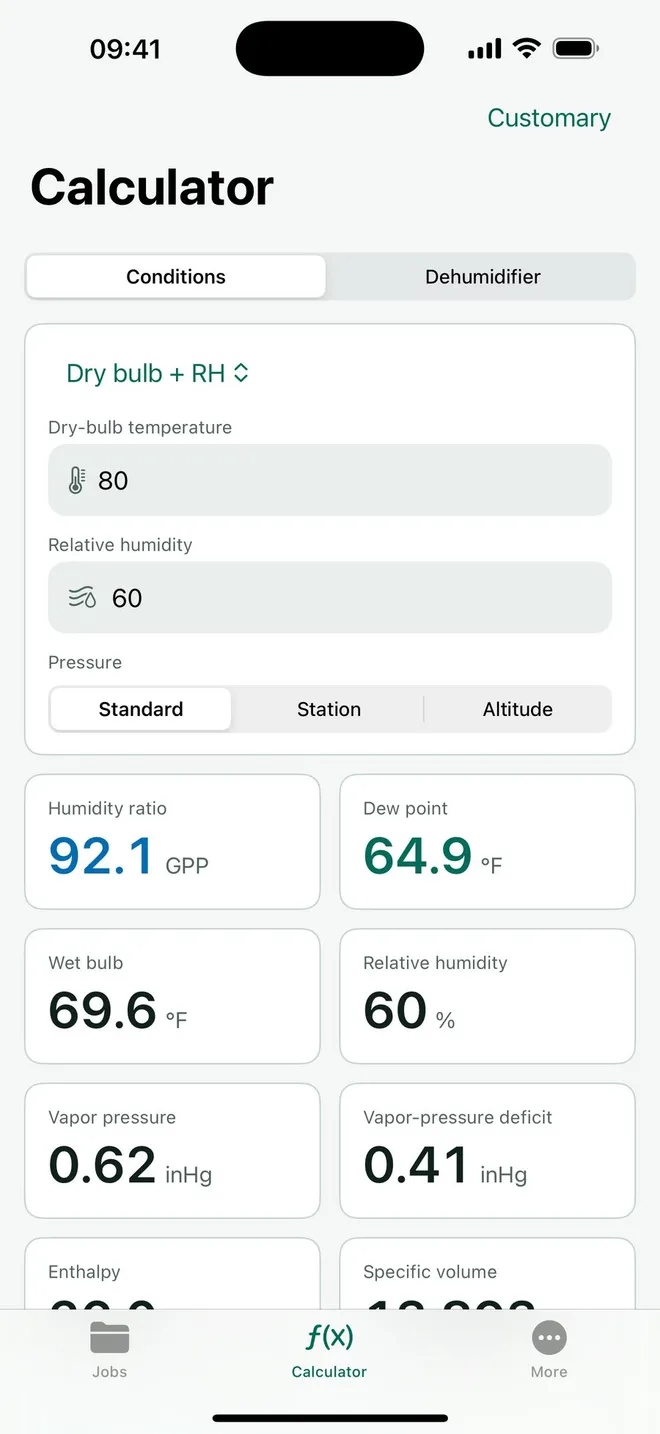
Restoration Drying Calc accepts dry-bulb temperature paired with relative humidity, wet bulb, dew point, or humidity ratio. It calculates GPP, dew point, wet bulb, vapor pressure, enthalpy, specific volume, and VPD. Keep the original measurements in the job record so a reviewer can see what went into the calculations.
- Create the job, zone, and room.
- Measure the air and material points.
- Enter the air pair and record the calculated result.
02 / Practical steps
Use GPP to compare air conditions
GPP means grains of water vapor per pound of dry air. It expresses absolute moisture content differently from relative humidity, which changes with temperature. If you compare two air conditions, record each complete input pair and use the same units and method. A lower GPP can show that one air mass contains less water vapor, but it does not by itself tell you whether a wall or floor is dry.
The app can compare two conditions side by side. Use that view to discuss an inlet and outlet or two spaces, then return to the room log for material readings. Dew point gives another useful view of the air condition, especially when surfaces may be cool enough for condensation.
Use the real app
Restoration Drying Calc
Calculate air conditions in the field, record monitoring visits by room, compare readings against your own goals, and share a clear drying report.
Offline field calculator and drying log

Enter dry-bulb temperature with RH, wet bulb, dew point, or humidity ratio; see GPP, dew point, VPD, and related results.
03 / Practical steps
Keep each monitoring visit independent
A new visit can reuse the prior visit’s room and point structure, but its readings should start blank. That prevents yesterday’s numbers from appearing as if they were measured today. Read and enter each point again, attach a moisture photo if useful, and make a note when equipment or conditions changed.
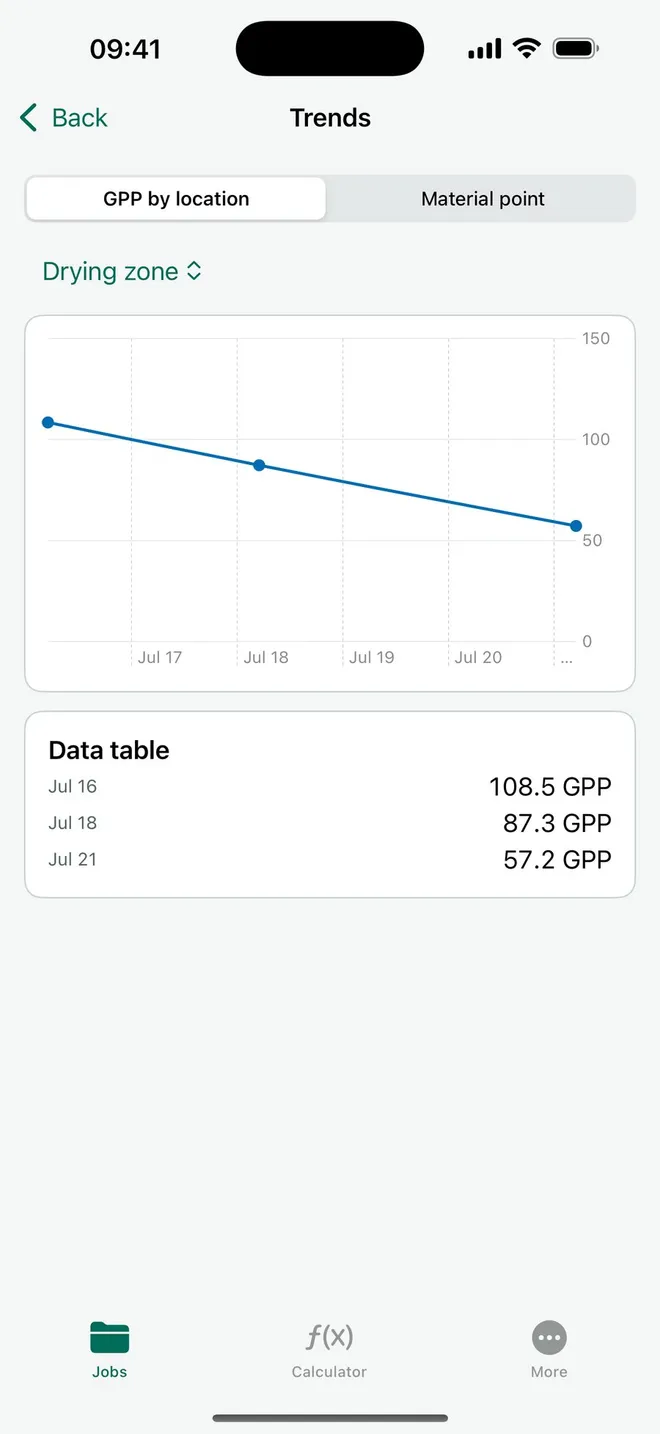
Trends are clearest when a point has the same name, location, instrument setting, and material context across visits. Set goals based on your own reference measurements and job protocol. The app tracks points against those goals; it does not decide the dry standard for you.
Source: EPA guidance on moisture measurement after flooding.
04 / Practical steps
Close the loop with a readable drying report
Before sending a report, look for missing visits, rooms without material readings, points that changed location, and unusually large jumps that need an explanation. Review GPP and material trends together with the job notes. Mark a job complete only when the real work and your professional criteria support it.
Restoration Drying Calc creates room-by-room PDF and CSV reports you can share with an adjuster, client, or teammate. It works offline in the field, so the record does not depend on a signal at the jobsite. Export is a way to communicate measurements and decisions, not a certification of the drying outcome.
Frequently asked questions
Drying log and GPP FAQ
What does GPP measure?
Grains per pound expresses the mass of water vapor per pound of dry air. It is useful for comparing air conditions when you retain the original measurements and units.
Can I calculate GPP from temperature and relative humidity?
Yes. Enter dry-bulb temperature and relative humidity into the app; it calculates GPP and related psychrometric values.
Does a lower GPP prove that building materials are dry?
No. Material readings, reference conditions, site observations, and professional judgment are still needed.
Can I work without internet access?
Yes. The calculator, job records, and reporting workflow are designed to work offline.
Restoration Drying Calc is a calculation and documentation aid, not a dry-standard authority or a substitute for professional judgment.