Free tool · Salon Pricing Calculator
Salon hourly rate calculator
Your salon hourly rate is the revenue your year needs divided by the hours clients actually book: income goal ÷ (1 − tax set-aside), plus yearly costs, ÷ (1 − card-fee share), then ÷ (bookable hours × booking rate × working weeks). With the sample numbers below that is 75.57 an hour.
Enter yearly amounts in your own currency. Percentages as numbers (20 = 20%). Nothing you enter leaves your browser.
Hourly rate for the sample numbers: 75.57. Turn on JavaScript to enter your own.
How is a salon hourly rate calculated?
Start from the year, not the appointment. A chair has to pay for three things before a single service is priced: the money you want to keep, the tax you owe on it, and the costs of running the business. Then all of that has to come out of the hours clients actually book, which is always fewer than the hours you are open. The calculator follows the same four steps as the hourly-rate screen of Salon Pricing Calculator, with no rounding until the final display.
- Gross income needed = take-home goal ÷ (1 − tax set-aside). The set-aside applies to your income, not to your costs.
- Required revenue = (gross income needed + yearly fixed costs) ÷ (1 − share-of-revenue costs). Card fees grow with revenue, so they sit in the divisor.
- Billable hours = bookable hours per week × booking rate × working weeks.
- Hourly rate = required revenue ÷ billable hours. Cost per minute is that rate ÷ 60, and clients per week is required revenue ÷ average ticket ÷ working weeks.
Worked example: what does a 60,000 take-home goal need per hour?
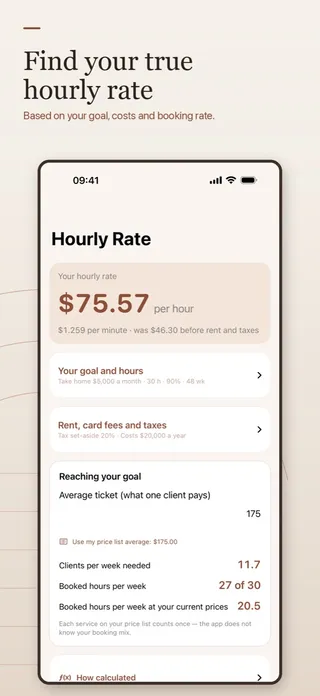
These are the numbers on the app's own Hourly Rate screenshot above: a stylist who wants to keep 60,000 a year (5,000 a month), sets aside 20% for tax, pays 1,400 a month in rent plus 3,200 a year of other costs, loses 3% of revenue to card fees, can book 30 hours a week, fills 90% of them and works 48 weeks.
- Gross income needed
- 60,000.00 ÷ (1 − 20%) = 75,000.00
- Fixed costs a year
- 1,400.00 × 12 + 3,200.00 = 20,000.00
- Required revenue
- (75,000.00 + 20,000.00) ÷ (1 − 3%) = 97,938.14
- Billable hours
- 30 × 90% × 48 = 1,296
- Hourly rate
- 97,938.14 ÷ 1,296 = 75.57
- Cost per minute
- 75.57 ÷ 60 = 1.259
- Clients per week
- 97,938.14 ÷ 175 ÷ 48 = 11.7
Without the card fees the same stylist would need 73.30 an hour: 95,000 ÷ 1,296. Three percent of revenue looks small, but it moves every price on the menu by about 3%. If the book is only 80% full instead of 90%, billable hours fall to 1,152 and the rate climbs to 85.02.
Which numbers should I enter?
Take-home goal
What you want to keep for yourself in a year, before income tax. If you think in months, multiply by 12; the app asks the same question as "I want to take home" per month.
Booking rate
The share of your bookable hours that clients actually fill, over a normal month. Count gaps, no-shows and last-minute cancellations as unbooked. Most mistakes in salon pricing come from assuming a full book: a 100% booking rate quietly hands every empty hour to you as unpaid time.
Fixed costs versus share-of-revenue costs
Rent, insurance, licences, software, education and equipment are fixed: they cost the same whether you do ten services or forty. Card processing is a share of each payment, so it goes in the percentage field. Product used on a specific service belongs to that service's price, not to the hourly rate; the service price calculator adds it per appointment so it is never counted twice.
What do I do with the hourly rate?
Multiply it by each service's full seat time, including processing time you cannot sell to someone else, add the product used, and apply your target margin. That gives a price you can defend and a floor you should not go under. If your current menu sits well below the result, the price-raise guide shows how to close the gap in steps. If you are deciding between renting a booth and staying on commission, run the same year through the booth rent comparison.
The result is a business scenario built from your inputs. It does not know your local market, and your tax set-aside is your own estimate, not tax advice.
Sources
Questions people ask
How much should a hairstylist charge per hour?
Enough that the hours clients actually book cover your take-home goal, the tax you set aside, your rent and other costs, and any fees taken as a share of revenue. With a 60,000 goal, a 20% set-aside, 20,000 of yearly costs, 3% card fees and 1,296 booked hours, that is 75.57 an hour. Your own numbers give your own answer.
Why does the booking rate matter so much?
Because the year’s revenue has to come from booked hours only. At 90% of 30 hours you sell 27 hours a week, not 30. Dropping from 90% to 80% raises the hourly rate needed by one eighth, with every other number unchanged.
Should the tax set-aside apply to my costs too?
No. The calculator, like the app, applies the set-aside to the income you want to keep: goal ÷ (1 − set-aside). Business costs are added afterwards. The percentage is your own estimate; ask a tax professional what fits your situation.
Where do card processing fees go?
Into the share-of-revenue field. A fee that takes a percentage of every payment grows with revenue, so it divides the required revenue instead of being added as a fixed amount. Fixed costs such as rent, insurance and software go in the fixed fields.
What is cost per minute used for?
It is the hourly rate divided by 60. Multiply it by a service’s minutes to see what that service’s time must bring in before products, so a 45-minute service and a 150-minute service are priced from the same base.