Small, steady, and forgiving
How to build a daily Bible reading habit that lasts
Start smaller than you think, at the same moment every day. Read one verse or a short passage right after something you already do, spend five minutes with it, and when you miss a day, simply start again with today instead of catching up.
There is no required amount or time of day. The rhythm below is a starting point for people who want to read daily and keep finding that the plan falls apart.
No account · no ads · stays on your device
01 / Why plans stall
Why daily Bible reading is hard to keep up
Most people who want to read the Bible every day start with real enthusiasm, often in January, and many have stopped by February. That is rarely a lack of faith. More often the plan was built for a perfect week, and ordinary weeks are not perfect.
The goal is too big
Three or four chapters a day is a fine goal for later. At the start it turns every busy morning into a small failure, and a few of those are enough to quit.
There is no set moment
“Sometime today” competes with everything else. Without a fixed cue, the reading slides to bedtime and then to tomorrow.
Missed days pile up
Calendar plans mark you behind the moment you miss one. Facing three overdue readings feels like debt, so the plan gets abandoned instead.
Each of these has a simple fix: a smaller starting point, a fixed moment in the day, and a clear rule for what to do after a miss. The rest of this guide takes them one at a time.
02 / Start small
Start with one verse, not a chapter quota
A habit forms by repeating something in the same situation until it becomes almost automatic. What matters early on is how often you do it, not how much you do each time. So make the first version small enough that even a bad day cannot stop it: one verse, read slowly, twice.
Think of it as two versions of the same habit. The floor is the smallest thing that still counts, such as one verse and one sentence of prayer. The full version is what you do when there is time: the surrounding passage, a few lines in a journal, a longer prayer. On a hard day you do the floor and the habit stays alive. On a good day you go further, and nobody needs to keep score.
A floor you can keep on any day
- Read one verse, then read it again more slowly.
- Notice one word or phrase that stands out.
- Say one sentence of prayer in response.
- Stop there if that is all today allows.
03 / Time and cue
Tie your reading to something you already do
The most reliable reminder is not a notification. It is an action you already take every day. Pick one, and finish this sentence: “After I ______, I will read today’s verse.” Put your Bible or your phone where that moment happens, so the cue and the reading are in the same place.
After the first coffee or tea
Quiet for many people, and it sets the tone for the day. Read before opening email or the news, so the verse comes first.
At the start of a lunch break
Useful when mornings belong to children or a commute. Five minutes in the car or at your desk is enough.
After getting into bed
Reading before sleep works well if you are not too tired. Leave the phone face down afterward, and keep the verse as the last thing you read.
Morning has a long history in Christian devotion. Of Jesus, Mark writes: “And in the morning, rising up a great while before day, he went out, and departed into a solitary place, and there prayed” (Mark 1:35, KJV). But the point of a set time is that you keep it, so choose the one that fits your real week.
Then add one reminder as a backup for the days the cue slips. Set it a few minutes after your usual moment, so it only nudges you when you have forgotten. If a Bible app’s reminder never arrives, open the Settings app, tap Notifications, tap the app, and make sure Allow Notifications is on. If you use Scheduled Summary, leave that app out of it, or the reminder will wait for the next summary.
Notification steps follow Apple’s Change notification settings on iPhone.
04 / Five minutes
A five-minute routine for each day’s verse
Using the same few steps every day removes the question of what to do once you sit down. If you know the SOAP method (Scripture, Observation, Application, Prayer), this is a lighter version sized for a single verse.
- Read
Read the verse aloud or slowly in your head, then read it once more. If you have time, read the verses around it so you know who is speaking and why.
- Notice
Pick out one word or phrase that stands out. You do not need to know why yet.
- Ask
Ask one question, such as “What does this show me about God?” or “Where does this meet my day?”
- Respond
Write one or two sentences, or one small thing you will do today. A dated line is enough to look back on later.
- Pray
Turn what you noticed into a short prayer, and add anyone who came to mind to your prayer list.
Journal prompts for days when nothing comes
- What is one thing this verse says plainly?
- Is there something here to give thanks for?
- Is there something here to ask for, or to let go of?
- Who could I share this verse with today?
05 / Missed days
What to do when you miss a day
You will miss days. Illness, travel, and a newborn all happen. What decides whether the habit survives is what you do on the day after. The rule is simple: start with today’s reading, and do not try to catch up. Reading three days at once turns a quiet habit into a backlog, and backlogs are what make people quit.
Research on everyday habits supports going easy on yourself. In a study of 96 volunteers building a daily habit, it took an average of 66 days for the behavior to feel close to automatic, with individual times ranging from 18 days to a projected 254 days. Just as useful: a single missed day had little impact on later progress. Many small repetitions matter more than an unbroken streak.
That fits the tone of Scripture as well: “It is of the LORD’s mercies that we are not consumed, because his compassions fail not. They are new every morning: great is thy faithfulness” (Lamentations 3:22–23, KJV). Every morning is a fresh place to begin.
Getting back on track
- Missed one day: read today’s verse and carry on.
- Missed a week: go back to the floor version for a few days.
- Behind on a calendar plan: switch to a plan that continues from where you stopped.
- Lost the time slot: pick a new cue that fits this season.
Habit findings are from Lally, van Jaarsveld, Potts, and Wardle, “How are habits formed: Modelling habit formation in the real world” (European Journal of Social Psychology, 2010), as summarized by the British Psychological Society’s Research Digest.
06 / Choose a plan
When you are ready for more: choosing a reading plan
After a few weeks of the daily verse, many people want to read more continuously. A plan removes the daily decision about what to read. Match it to the time you actually have, and prefer plans that continue from where you stopped over plans tied to dates.
A short topical plan
One to three verses a day for one to four weeks on a theme like peace, gratitude, or hope. A good bridge from a single verse, with a clear finish line.
One book, one chapter a day
Choose a Gospel such as Mark or John, or read the Psalms. You follow one story or voice from start to finish, which makes each day easier to understand.
The whole Bible in a year
The Protestant Bible has 1,189 chapters, so a one-year plan means about three or four chapters a day. It is rewarding when the habit is already steady.
If your church preaches through a book, reading the next passage during the week is an easy way to connect Sunday to the rest of your days. Our guide on how to take sermon notes shows how to keep that message with you after the service.
A daily verse, kept private
Keep the habit with VerseDaily
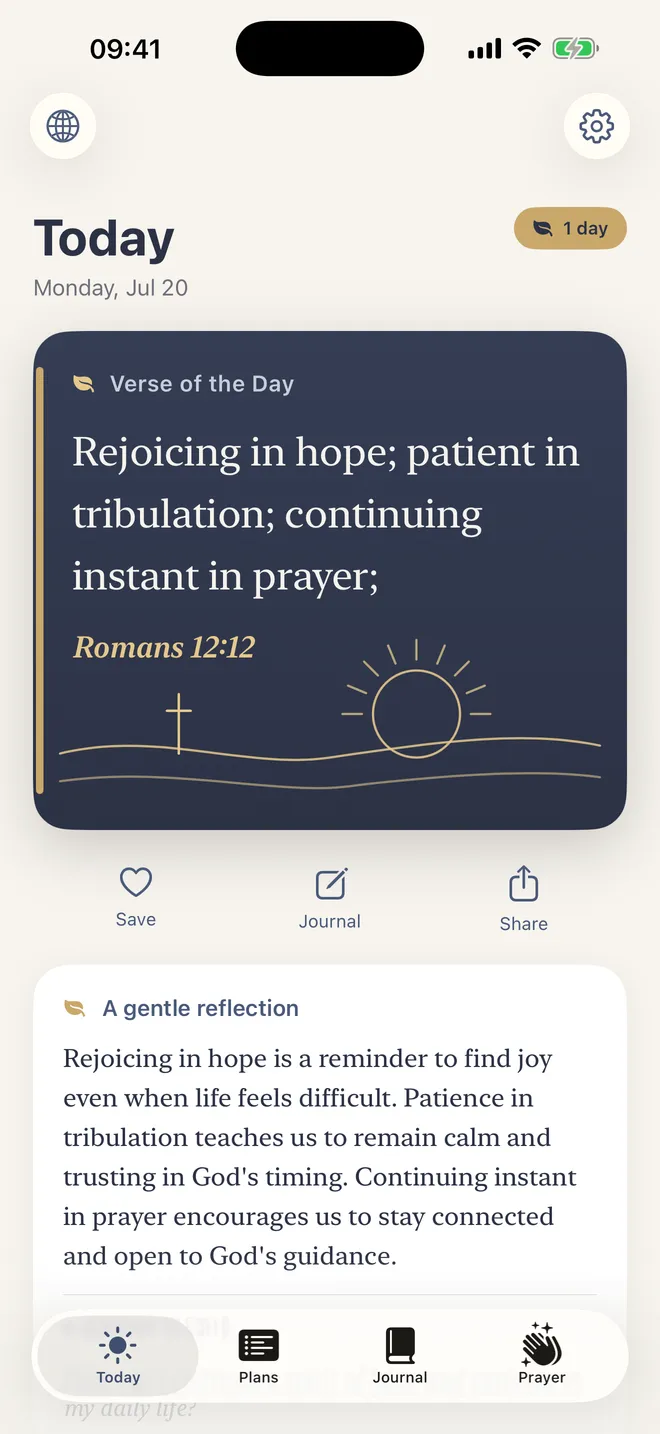
VerseDaily is a daily Bible verse app for iPhone and iPad, built around the small routine above. Each day opens to a new verse from a collection of 366, so a full year passes before one repeats. The verses cover a wide range, from comfort and gratitude to grief, doubt, and courage. Below the verse are a short reflection and one question to carry. On iOS 26 devices with Apple Intelligence, the reflection is written by Apple’s on-device model; on other devices, VerseDaily shows a built-in reflection instead. Tap Journal to write about today’s verse with the reference already filled in, or Save and Share to keep it or send it as an image card.
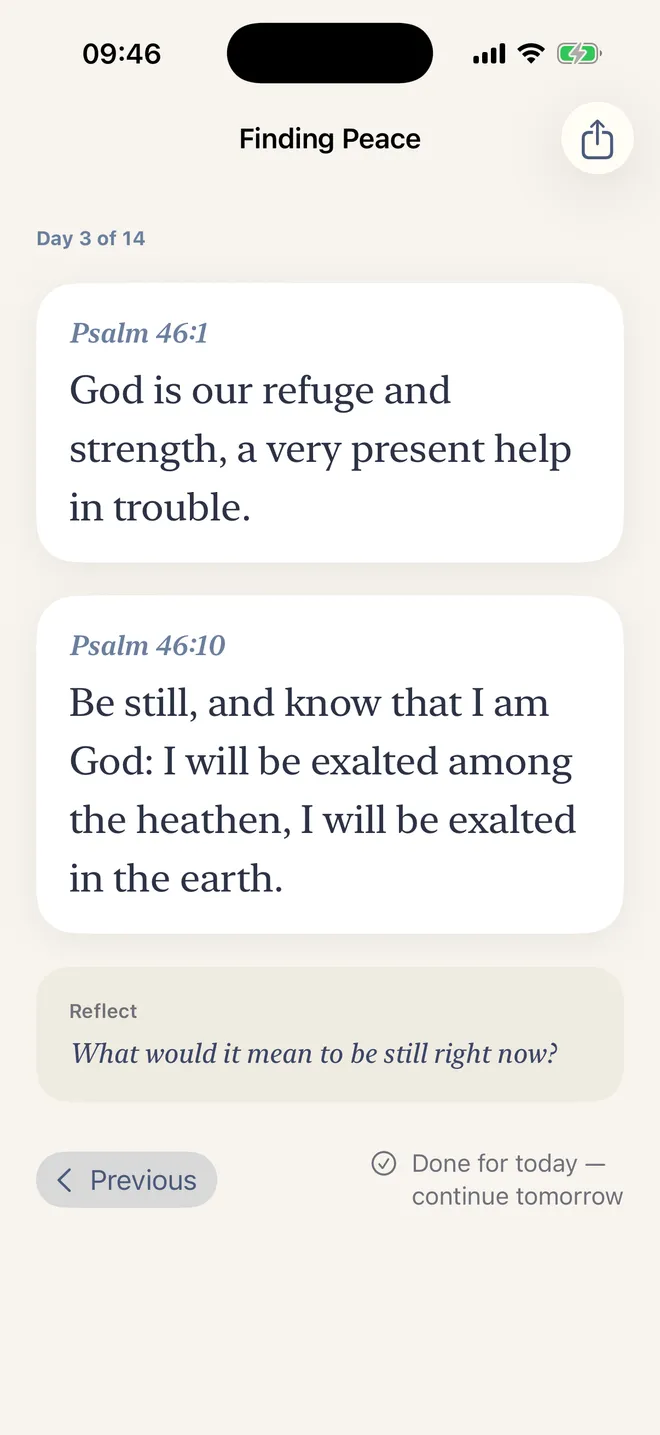
Set a daily reminder at a time you choose during setup or in Settings. The day count on the Today screen is gentle: missing a single day does not reset it. Reading plans such as Finding Peace, 30 Days in the Psalms, Gratitude, and Hope in Hard Times move at most one day per calendar day, and when you miss a day the plan simply waits for you. A prayer list keeps what is on your heart in one place, with optional reminders and a way to mark prayers answered.
VerseDaily has no account, no ads, no analytics, and no server. Your journal, prayers, saved verses, and plan progress stay on your device. VerseDaily is free to download. The daily verse, reflection, journal, prayer list, and the 14-day Finding Peace plan are free, and an optional in-app purchase unlocks the other reading plans.
- For iPhone and iPad · iOS 17.0 or later
- 366 verses, one each day, in six public-domain translations
- King James Version, Reina-Valera 1909, Louis Segond 1910, Almeida 1911, and the Chinese Union Version
- Private journal with search, and a prayer list
- Daily reminder at a time you choose
- Switch languages from the Today or Plans screen
No account · no ads · stays on your device

No account and no ads. Your journal and prayers stay on your iPhone or iPad.
Frequently asked questions
Daily Bible reading FAQ
How long should daily Bible reading take?
As long as you can keep doing on an ordinary day. For most beginners that is five to ten minutes. A short time you protect every day builds more than a long session you manage twice a month. Once the habit feels automatic, lengthen it on days when you have room, and keep the short version for busy ones.
Is reading one verse a day enough?
It is a good place to start, not a ceiling. One verse read slowly, with a question and a short prayer, gives the habit a cue and a routine you can keep. As it settles, add the verses around it, a short reading plan, or a chapter a day. The aim is to keep coming back, and a small start makes that easier.
What is the best time of day to read the Bible?
The best time is one that follows something you already do every day, such as making coffee, a lunch break, or getting into bed. Morning is traditional and has fewer interruptions for many people, but a steady evening habit is better than a morning plan that keeps slipping. Choose one time and keep it for a few weeks before changing it.
What should I do if I miss several days of Bible reading?
Start again with today’s reading and skip the catch-up. Reading three days at once turns a quiet habit into a chore, and a single missed day has little effect on how habits form. If a calendar-based plan now feels far behind, move to a plan that simply continues from where you stopped, or begin a short new one.
Should I read the Bible in an app or on paper?
Either works; use whichever you will actually open. A printed Bible has no notifications and suits longer reading and marking the page. An app is always with you and can remind you at the time you choose. Many people use both: an app for the daily cue and a verse, and a printed Bible when they have time to read the whole chapter.
Does VerseDaily need an account or collect my data?
No. VerseDaily has no account or sign-up, no ads, no analytics, and no server. Your journal entries, prayers, saved verses, and plan progress are stored on your device, and the scripture text is bundled in the app. Notifications and saving a verse image to Photos are optional permissions you can change in the Settings app.
Which Bible translations and languages does VerseDaily use?
VerseDaily uses public-domain translations in six languages: the King James Version in English, Reina-Valera 1909 in Spanish, Louis Segond 1910 in French, Almeida Revista e Corrigida 1911 in Portuguese, and the Chinese Union Version in Simplified and Traditional Chinese. It runs on iPhone and iPad with iOS 17.0 or later.
VerseDaily is an independent product of Neobile LLC. iPhone, iPad, and Apple Intelligence are trademarks of Apple Inc. Other names belong to their respective owners. Scripture quotations are from the King James Version, which is in the public domain. Habit research is summarized for general encouragement; it is not a promise about how long any habit will take.