A practical passage-reading workflow for educators
How to conduct an oral reading fluency assessment
Choose the correct passage and scoring protocol, time the read, and mark miscues as they happen. Record the last word attempted, scored errors, self-corrections, and exact elapsed time. Then calculate WCPM and accuracy, preserve the raw counts, and interpret the result with the benchmark and other reading evidence your school requires.
WCPM is useful, but it does not by itself measure comprehension or fully describe prosody. Use your approved administration rules, equivalent passages, and published benchmark source.
Running record and oral reading fluency tools for educators
01 / Prepare the assessment
Decide the passage, purpose, and scoring rules first
Before the student begins, identify whether the read is a universal screening check, a benchmark, progress monitoring, or an informal instructional sample. That purpose controls which passage, directions, duration, error rules, and comparison source are appropriate.
Have these items ready
- A passage you have permission to use and that matches the required difficulty.
- The exact directions and timing rule from your assessment system.
- A clear definition of errors, self-corrections, insertions, repetitions, and supplied words.
- The benchmark or target source, if the result will be compared with one.
- A plan for recording comprehension, prosody, or instructional observations separately.
Keep the same convention across repeated measures. A number is difficult to interpret when one session counts insertions as errors and another does not, or when passages differ substantially in difficulty.
The National Center on Intensive Intervention describes passage-reading fluency as a measure of accuracy, rate, prosody, and comprehension, with WCPM used for progress monitoring. See its passage reading fluency summary.
02 / Run the read
Follow one consistent sequence from start to stop
- Give the approved directions
Explain what the student should do and what happens when a word is difficult. Avoid adding prompts that change the standard procedure.
- Start timing with the first word
Use the required duration. If the read is not exactly 60 seconds, retain the exact elapsed time so WCPM can be normalized correctly.
- Mark observable reading events
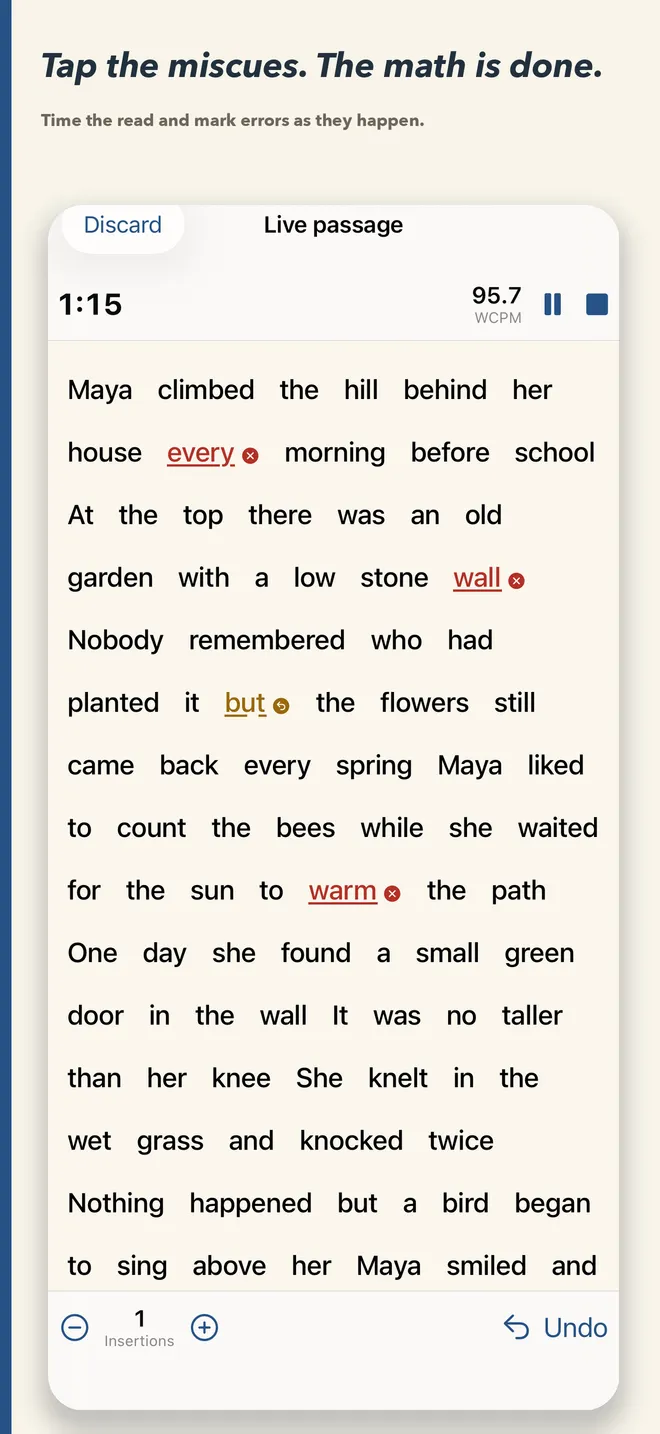
Record substitutions, omissions, supplied words, insertions, and self-corrections according to your selected convention. Undo a mark when you make a scoring tap by mistake.
- Identify the stopping word
At the time limit, mark the final word attempted. If the student finishes early, record the actual elapsed time rather than assuming one minute.
- Finish the rest of the protocol
Complete any retell, comprehension questions, prosody rubric, or teacher notes required by the assessment system.
03 / Preserve the evidence
Keep the raw counts beside every calculated score
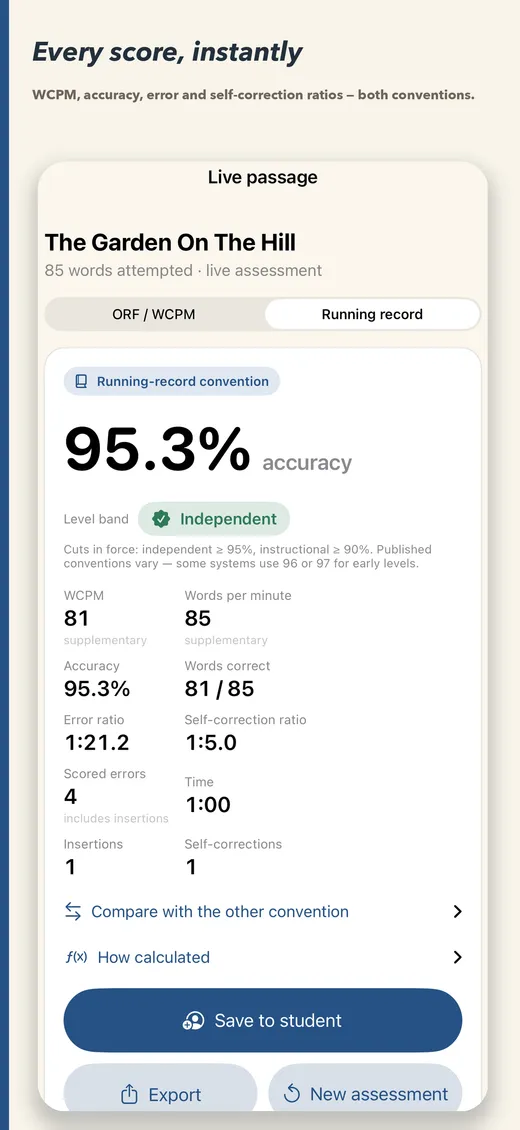
A useful record shows how the result was produced. Save words attempted, scored errors, self-corrections, insertions when relevant, exact time, passage title, date, scoring convention, and any benchmark entered by the educator. Then a colleague or future you can understand the number.
Correct words
Words attempted − scored errors
WCPM
Correct words ÷ elapsed seconds × 60
Accuracy
Correct words ÷ words attempted × 100
Instructional context
Passage + convention + benchmark source + notes
Look for patterns across multiple comparable checks rather than overreacting to a single score. Consider whether changes reflect reading growth, passage difficulty, attention, unfamiliar vocabulary, administration conditions, or scoring differences.
One assessment, clearly labeled
FluencyCalc handles live marking and final calculations
Start with the built-in original practice passage, or paste, type, scan, or select a passage you are permitted to use. Tap words to mark errors and self-corrections while the student reads. FluencyCalc calculates WCPM, accuracy, error ratio, and self-correction ratio, and puts Save to student and Export right under the scores. A growth chart makes saved reads easier to review over time.
- Live tap-marking or quick entry
- Separate ORF and running-record rules
- Student history and growth charts
- PDF and CSV exports
Running record and oral reading fluency tools for educators
04 / Continue the workflow
Choose the next teacher guide
Frequently asked questions
Oral reading fluency assessment FAQ
What does an oral reading fluency assessment measure?
A passage-reading fluency assessment commonly records accuracy and rate, often reported as words correct per minute. A broader view of fluency also considers expression or prosody and comprehension, which WCPM alone does not measure.
How do I calculate WCPM for a reading longer than one minute?
Subtract scored errors from words attempted, divide correct words by the exact elapsed seconds, and multiply by 60. This normalizes the result to words correct per minute.
Should insertions count as errors?
That depends on the scoring convention. FluencyCalc keeps its ORF/WCPM and running-record conventions separate and clearly labeled. Apply the rules required by your assessment system.
Can I use any passage?
Use a passage you have the right to use and that fits your assessment purpose. For comparisons over time or against norms, passage difficulty and administration conditions must match the system that produced the benchmark.
Does FluencyCalc interpret the result for me?
No. The app calculates and stores the data. Educators select the passage, apply the correct scoring rules and benchmark source, consider comprehension and other evidence, and make instructional decisions.
FluencyCalc is a calculation and record-keeping tool for educators. It does not provide reading passages, diagnose a student, or replace the administration, scoring, benchmark, and interpretation rules required by your school or assessment system.