A simple progress-monitoring system for educators
How to track reading fluency progress without losing the context
Use comparable passages and the same administration rules, then graph WCPM and accuracy across multiple dates. Keep the raw counts, exact time, scoring convention, passage, benchmark source, and teacher notes with every result. Review the trend alongside prosody, comprehension, instruction, attendance, and other reading evidence.
One score is a snapshot. A trend is only meaningful when the passages and conditions support comparison and the educator applies the decision rules from the approved assessment or intervention system.
Running record and oral reading fluency tools for educators
01 / Build a repeatable system
Make every data point comparable and understandable
- Define the purpose
Separate seasonal benchmarking, intervention progress monitoring, and informal instructional checks. Each purpose may require different passages, frequency, and decisions.
- Choose approved comparable forms
Use passages and administration directions from the system your school requires. Do not assume two texts are equivalent because they have a similar word count.
- Keep the scoring convention fixed
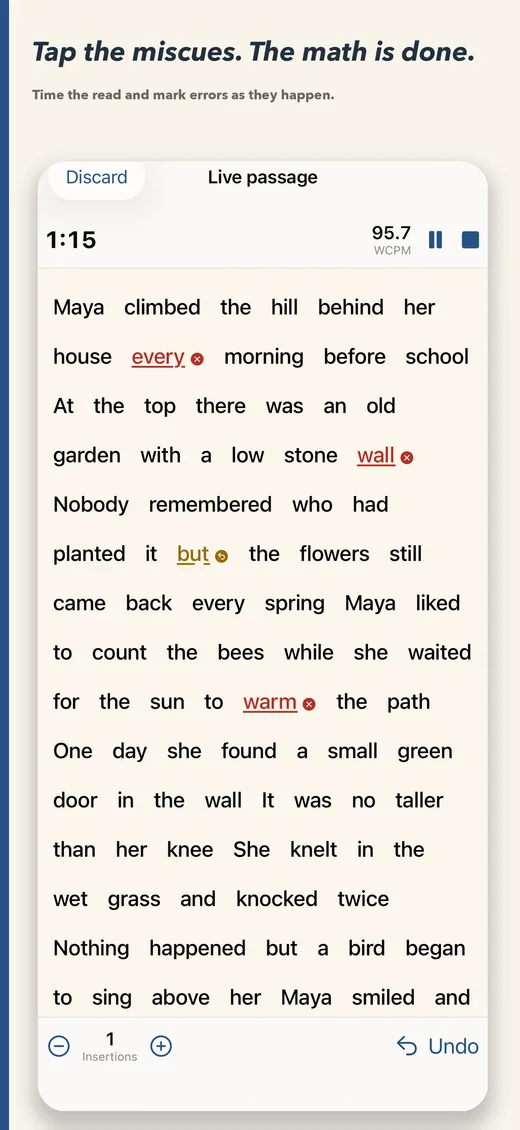
Apply the same rules for errors, insertions, self-corrections, supplied words, and timing across the series.
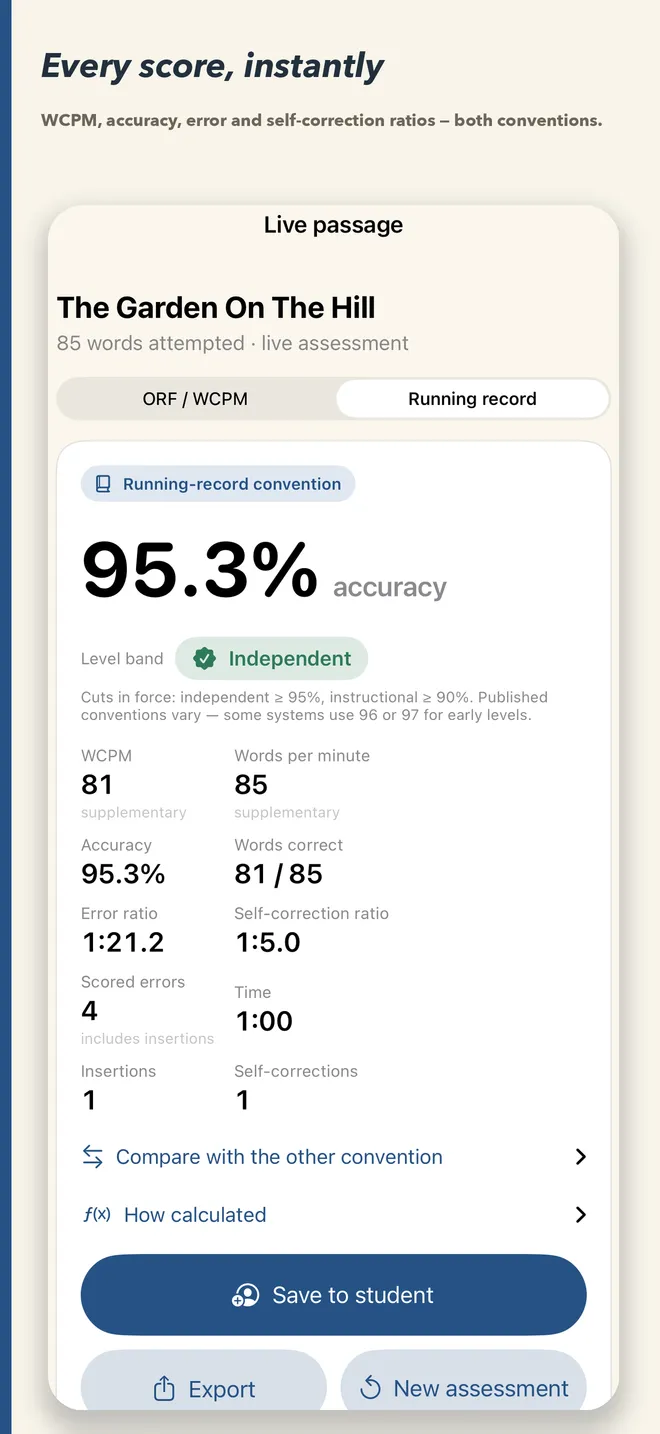
- Save raw data and context
Retain words attempted, scored errors, time, passage, date, notes, and any educator-entered target with WCPM and accuracy.
- Review and respond
Use the trend with other evidence to continue, adjust, intensify, or reconsider instruction according to your intervention framework.
The National Center on Intensive Intervention describes oral reading fluency measures as tools for observing performance across multiple time points. See its review of oral reading fluency progress monitoring.
02 / Read the pattern
WCPM and accuracy can move in different directions
More words read correctly with control
Look for the same improvement across comparable forms and confirm that expression and understanding remain appropriate.
Speed may be outrunning precision
Review error patterns, decoding demands, and whether the student is rushing. A higher raw pace does not automatically mean stronger fluency.
Word reading may be becoming more secure
Improved accuracy can be meaningful even before rate changes. Consider phrasing, automaticity, and the difficulty of the passage.
Check the conditions before concluding
Look at passage comparability, vocabulary, attendance, fatigue, instruction, administration, and scoring consistency.
Do not let the graph replace the assessment record. Open the underlying date, passage, counts, and notes when a point is surprising. The purpose of the chart is to guide questions and decisions, not to generate a diagnosis by itself.
03 / Connect data to teaching
Turn the trend into one testable instructional response
Accuracy need
Review decoding, word recognition, and the specific kinds of errors observed in the approved assessment record.
Rate need
Consider whether accurate reading is effortful and whether supported oral reading or repeated reading fits the instructional plan.
Prosody need
Observe phrasing, expression, and attention to punctuation rather than treating pace as the entire definition of fluency.
Comprehension need
Use retell, questions, discussion, and written evidence. WCPM alone cannot show whether meaning was understood.
Record the response you choose and the date of the next comparable check. When the next point arrives, evaluate both the student’s growth and whether the instructional change had the intended effect.
History that stays with the student
Use FluencyCalc to preserve the series, not just the latest score
Save assessments by student, view WCPM and accuracy trends, compare with your own entered target, and open the underlying record when you need the counts or notes. Export individual PDF reports, CSV data, a class summary, or a growth-chart card when appropriate.
- WCPM and accuracy trends
- Educator-entered targets
- Assessment history and notes
- Offline on iPhone and iPad
Running record and oral reading fluency tools for educators
04 / Keep the workflow consistent
Choose the next FluencyCalc guide
Frequently asked questions
Reading fluency progress-monitoring FAQ
What should I track for reading fluency progress monitoring?
Keep the passage or form, words attempted, scored errors, exact time, WCPM, accuracy, date, scoring convention, and relevant notes. Also record prosody and comprehension evidence when your protocol requires them.
How often should oral reading fluency be monitored?
Use the schedule defined by your screening, intervention, or assessment system. Students receiving targeted support may be checked more often than students participating only in seasonal benchmarks, but the interval should match the purpose and available equivalent forms.
Should I compare scores from different passages?
Only when the passages are intended to be comparable for that purpose. Passage length, difficulty, vocabulary, genre, and administration conditions can change performance, so preserve the passage information with each result.
Is a higher WCPM always better?
No. Rate must be considered with accuracy, expression, comprehension, text difficulty, and the student’s learning context. Faster inaccurate reading is not the same as stronger fluency.
Can FluencyCalc graph progress against a target?
Yes. Educators can save student history, view WCPM and accuracy trends, and enter their own WCPM benchmark for comparison. The app does not bundle a norm table.
FluencyCalc records and calculates educator-entered reading data. It does not supply norms, prescribe monitoring frequency, diagnose a student, or replace the passages and decision rules required by your school or intervention system.