Free due-date tool for eight species
Livestock gestation calculator
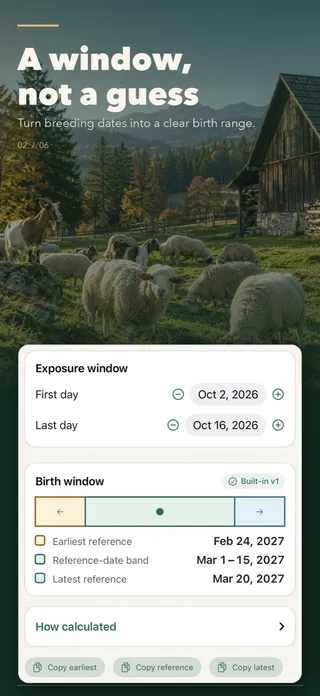
Pick the species and enter the breeding date: the calculator adds the shortest, typical and longest gestation from a cited extension or veterinary source and shows the earliest, central and latest birth date. For a group, enter the first and last exposure day; to plan ahead, work backward from the birth dates you want.
Gestation and due-date calculator
Enter one breeding date, or the first and last day the male ran with the group. Work back from a target birth date with “Plan backward”.
- Earliest reference
- Sun, Mar 7, 2027
- Central reference
- Thu, Mar 11, 2027 – Sat, Apr 24, 2027
- Latest reference
- Wed, Apr 28, 2027
- Outer breeding window
- —
- Reference breeding band
- —
Cattle: 2026-06-01 + 279 days = 2027-03-07 · + 283 days = 2027-03-11 · 2026-07-15 + 287 days = 2027-04-28 · window 53 days
Nothing you enter leaves your browser. Dates are planning references, not guarantees.
How long is gestation in each species?
These are the eight profiles the calculator uses, identical to the built-in profiles in the app. “Minimum” and “maximum” bound the planning window; “reference” is the central value used for the middle date.
| Species | Birth event | Minimum (days) | Reference (days) | Maximum (days) | Source |
|---|---|---|---|---|---|
| Cattle | calving | 279 | 283 | 287 | University of Nebraska–Lincoln Beef — 279 to 287 days; 283 common for most breeds |
| Sheep | lambing | 144 | 147 | 150 | Penn State Extension — 144 to 150 days; about 147 per Penn State’s small-ruminant nutrition guide |
| Goats | kidding | 145 | 150 | 155 | Penn State Extension — 145 to 155 days, average 149; the app rounds to 150 for planning |
| Pigs | farrowing | 110 | 114 | 117 | Penn State Extension — most sows farrow at 110 to 117 days; about 114 on average |
| Horses | foaling | 335 | 340 | 342 | University of Minnesota Extension — usually 335 to 342 days; 340 is the common planning value |
| Alpacas | cria birth | 332 | 342 | 352 | MSD Veterinary Manual — range 332 to 352; 342 is the app’s midpoint |
| Llamas | cria birth | 332 | 342 | 352 | MSD Veterinary Manual — range 332 to 352; 342 is the app’s midpoint |
| Rabbits | kindling | 31 | 31 | 32 | Penn State Extension — 31 to 32 days |
For alpacas and llamas the source gives a range, and the 342-day reference is the app’s own midpoint of that range rather than a published average. The goat value of 150 days is a rounded planning figure. Values vary by breed, parity, litter size and management; species pages for cows, goats, sheep, pigs and horses list breed differences reported by extension services.
Worked example: one breeding date
A doe rabbit is bred on November 3, 2026. Rabbit gestation in the profile is 31 to 32 days.
Earliest: Nov 3 + 31 days = Fri, Dec 4, 2026
Reference: Nov 3 + 31 days = Fri, Dec 4, 2026
Latest: Nov 3 + 32 days = Sat, Dec 5, 2026
With such a short gestation the whole window is only two days long, so anything the doe needs for kindling has to be in place before the earliest date, not on the reference day.
Worked example: a ram with the ewes for five weeks
A ram goes in with the flock on October 5, 2026 and comes out on November 8. Nobody saw each mating, so the window has to cover a ewe bred on the first day and one bred on the last.
Earliest lamb: Oct 5 + 144 days = Fri, Feb 26, 2027
Central band: Oct 5 + 147 → Nov 8 + 147 = Mon, Mar 1, 2027 – Sun, Apr 4, 2027
Last lamb: Nov 8 + 150 days = Wed, Apr 7, 2027
Window length: 41 days
A two-cycle exposure like this gives a lambing season of more than six weeks. Breeders who want a tighter season shorten the exposure period or fit the ram with a marking harness and record the date each ewe is marked.
Worked example: planning backward for a September cria
You want alpaca crias born between September 1 and September 30, 2027, after the summer heat. Subtracting the gestation lengths gives the breeding dates:
Reference breeding band: Thu, Sep 24, 2026 – Fri, Oct 23, 2026
Outer bounds: Mon, Sep 14, 2026 – Mon, Nov 2, 2026
Breeding inside the reference band aims the typical birth at your target month; the outer bounds show how far a long or short pregnancy can move it. This is subtraction only — the right time to breed also depends on the animal’s condition, age and your veterinarian’s advice.
What does the app add?
The calculator answers one question at a time. Livestock Gestation Tracker keeps the answers: each animal or group gets a plan with a timeline from breeding to birth, your own tasks and notes, and a reminder before its window opens. A month calendar shows every calving, lambing, kidding, farrowing, foaling, cria and kindling window together and marks the weeks where they overlap. After the births you record the first and last observed dates and compare them with the plan. Exact-date windows are free for all eight species; the season calendar, reverse planning, unlimited plans and PDF or CSV reports need an in-app purchase. It works offline with no account, in English, Spanish, Portuguese, German and Japanese.
Livestock Gestation Tracker is an organizational aid, not veterinary advice. Reference dates vary by animal, breed, pregnancy and management conditions. Use your own records and your veterinarian or a qualified livestock professional for care decisions.
Sources
Questions people ask
How do I calculate a due date from a breeding date?
Add the species’ gestation length in days to the breeding date. Because gestation varies, add the shortest and longest typical lengths too: the result is a window, not a single day. For a goat bred on March 1, 2026 that is July 24 to August 3, with July 29 as the reference date.
What if the male was with the females for several weeks?
Enter the first and last day of exposure. The earliest date uses the first day plus the minimum gestation; the latest date uses the last day plus the maximum. Every female covered in that period should give birth inside the window.
Can I work backward from when I want babies born?
Yes. Choose “Plan backward from a birth date”, enter the earliest and latest birth dates you want, and the calculator subtracts the gestation lengths to give the breeding dates. It is date arithmetic, not a breeding recommendation.
Why does the calculator show three dates instead of one?
Real births spread around an average. The earliest and latest reference dates come from the shortest and longest gestation in the cited source; the central date uses its representative value. Plan supplies and labour for the whole window.
Where do the gestation lengths come from?
They are the same eight built-in profiles as the Livestock Gestation Tracker app, each from a university-extension or veterinary reference listed in the table on this page.
Is my data saved or sent anywhere?
No. The calculator runs in your browser and nothing you enter leaves it. To keep plans, reminders and a season calendar, use the app, which also keeps records on your device.