A practical breeding-season planning guide
How to calculate a livestock birth window from breeding dates
For one known mating date, add the species reference days and keep its early-to-late range visible. For a multi-day sire-exposure period, calculate from both the first and last exposure dates so the result stays a window rather than collapsing uncertainty into one guessed due date.
Gestation dates are planning references. They do not confirm pregnancy, predict an individual birth, or replace veterinary and farm-specific care decisions.
Breeding-window planning for small farms and homesteads
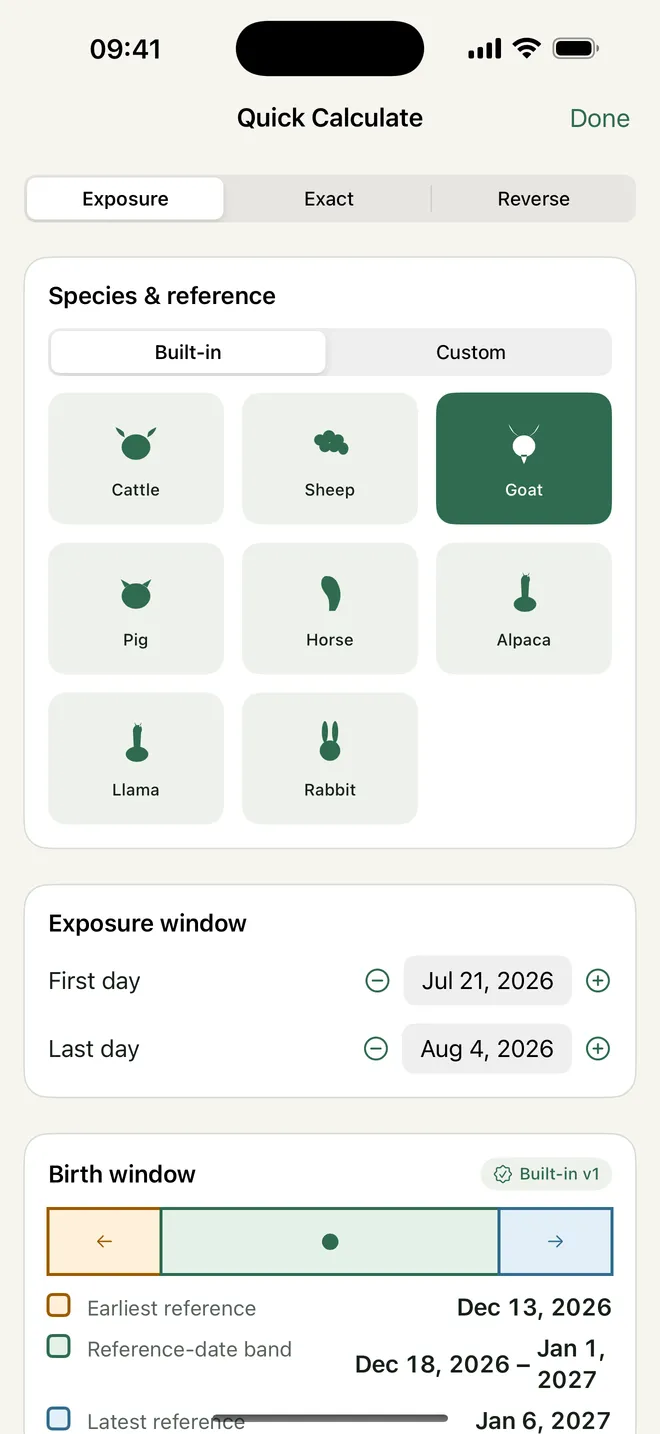
01 / Preserve what you actually know
Choose an exact date or an exposure period
Start with the breeding record, not the date you hope is correct. If artificial insemination or observed service gives you one reliable date, use an exact-date calculation. If a sire was present with a group from one date through another, enter that full exposure period.
Exact service date
- Use one documented date.
- The central reference band collapses to one reference date.
- The earlier and later profile limits still remain visible.
Sire-exposure period
- Keep both first and last exposure dates.
- The central reference band spans the possible service period.
- The full planning window becomes wider.
A broad exposure period is less precise, but that is useful information. It tells you that observation, facilities, staffing, and other plans may need to cover more days. Replacing the range with its midpoint would look cleaner while hiding the uncertainty in the original record.
Want the dates now? The free livestock gestation calculator does both calculations for all eight species in your browser, and has species pages for cows, goats, sheep, pigs and horses.
02 / Use transparent calendar-day arithmetic
How the birth window is calculated
Choose a species profile whose values and source you can review. Let S be the first exposure date and E be the last. For an exact service, S and E are the same date.
Earliest reference
S + the profile’s minimum days
Central band begins
S + the profile’s reference days
Central band ends
E + the profile’s reference days
Latest reference
E + the profile’s maximum days
The calculation should use civil calendar dates so a daylight-saving change cannot move a result by one day. Keep the selected profile snapshot with the plan because reference guidance may be updated later. The result is most useful when another person can see which values produced it.
For cattle, the University of Wisconsin Extension calculator also stresses that results depend on accurate input. Livestock Gestation Tracker exposes the source and caveat for every built-in profile.
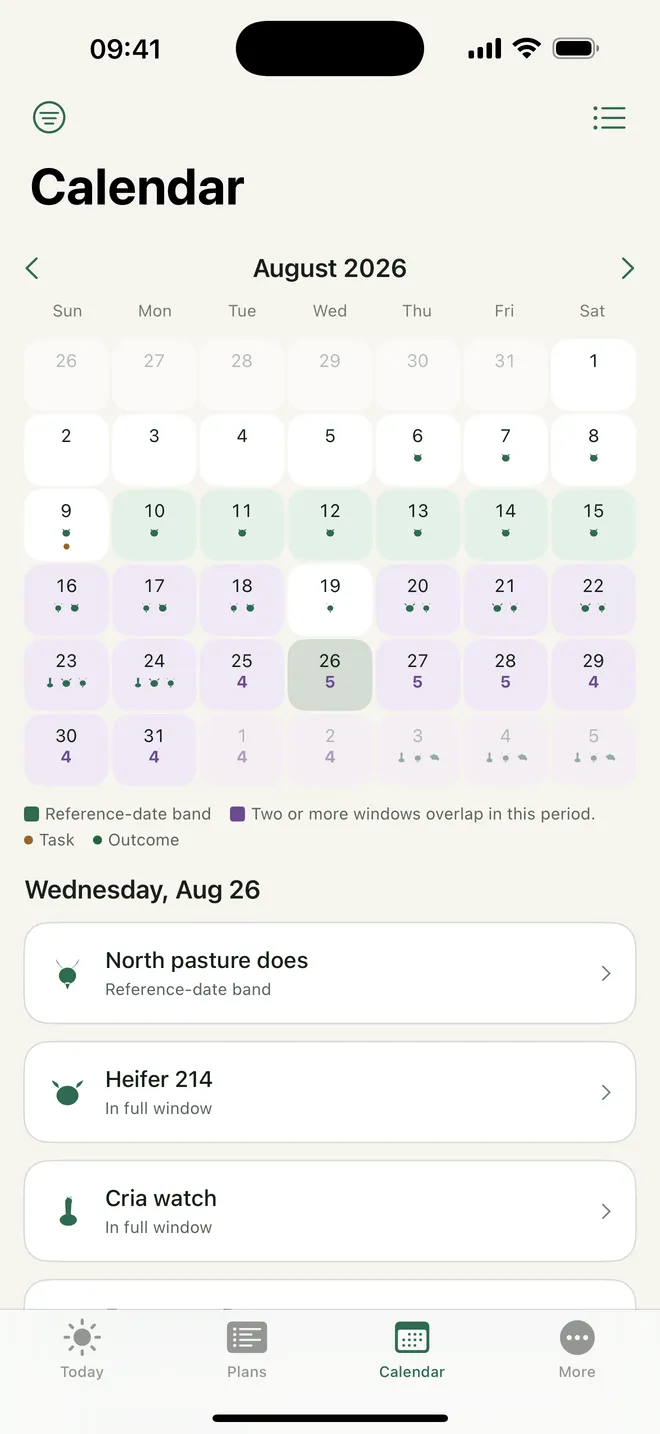
03 / Plan more than one animal
Turn separate calculations into a season calendar
A single due-date calculation answers one question. A season calendar answers the operational question: when will several animals or groups require attention at the same time? Save each plan with a clear animal or group label, species, source profile, and breeding origin. Then review the windows together by month or agenda.
Look for days where several full windows or central reference bands overlap. Use those areas to start conversations about observation coverage, space, supplies, and professional support. Add your own tasks without presenting general milestone dates as universal care instructions.
Useful plan details
- Animal ID or a non-sensitive group label
- Species and profile version
- Exact service or full exposure range
- Pregnancy status recorded by the user
- User-created preparation tasks
- First and last observed births for later record review
04 / Keep planning separate from diagnosis
Update the record when real information arrives
A calculated window remains a date-planning aid. Record confirmation, outcomes, and notes as facts from your own operation; do not let the calculator imply that an animal is pregnant or that a missed reference date is a diagnosis. When conditions are unexpected, use the care process established with your veterinarian or qualified livestock professional.
From one animal to the season
Livestock Gestation Tracker keeps the input, window, source, and calendar together
Use source-backed profiles for cattle, sheep, goats, pigs, horses, alpacas, llamas, and rabbits. Calculate from exact or exposure dates, reverse-plan from a desired birth period, save animals or groups, add tasks and outcomes, and review overlapping windows in a real calendar month offline. The first-launch guide walks through an animal and breeding date.
- Exact service dates
- Exposure-period windows
- Visible source profiles
- Reverse planning
- Season calendar and agenda
- Local backup and restore
Breeding-window planning for small farms and homesteads

Fully offline. Your farm records remain on the device.
Frequently asked questions
Livestock gestation calculator FAQ
How do I calculate a livestock due date from a breeding date?
Choose the species reference that matches your planning source and add its reference gestation days to the known service or mating date. Keep the source’s earlier and later reference limits visible as a planning window rather than treating the central date as a guarantee.
What if the sire was present for several days?
Keep the first and last exposure dates. Calculate the earliest planning date from the first exposure and the latest planning date from the last exposure. The central reference band should also widen across that exposure period instead of inventing one mating date.
Which animals does Livestock Gestation Tracker support?
The built-in profiles cover cattle, sheep, goats, pigs, horses, alpacas, llamas, and rabbits. Each profile shows its reference values, version, source, and caveat.
Can a gestation calculator confirm pregnancy or predict the exact birth date?
No. Date arithmetic cannot diagnose pregnancy or promise when an individual animal will give birth. Breed, pregnancy, health, and management conditions vary. Use your own records and a veterinarian or qualified livestock professional for care decisions.
Can I plan backward from a desired birth period?
Yes. Livestock Gestation Tracker includes reverse planning that starts with a desired birth window and calculates the corresponding reference breeding period.
Livestock Gestation Tracker is an organizational aid, not veterinary advice. Reference dates vary by animal, breed, pregnancy, and management conditions. Use current source material, your own records, and your veterinarian or a qualified livestock professional for care decisions.