Naglieri General Ability Tests · interactive practice
NGAT sample questions for K–2 and grades 3–5
Below are eight original practice questions in the three NGAT formats: Verbal (which picture does not share the idea), Nonverbal (complete the shape matrix) and Quantitative (find the number rule). Tap an answer to see whether it fits and why. They are practice, not an official score.
How to use this page: let your child choose an answer before you say anything. A green border means the choice fits the rule; then read the explanation together. Without JavaScript, open “Show answer” under each question.
Kindergarten to grade 2: four sample questions
Which picture does not belong?
Answer: C.
- Look at all six pictures.
- Five pictures show things used with food. The wheel does not belong to that group.
- Careful: the wheel is also in the group “things made by people”, like the other pictures, but not in “things used with food”.
Show answer
Answer: C. Look at all six pictures. Five pictures show things used with food. The wheel does not belong to that group. Careful: the wheel is also in the group “things made by people”, like the other pictures, but not in “things used with food”.
Which answer completes the pattern?
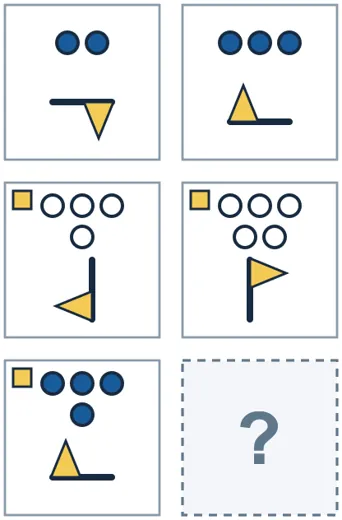
Answer: D.
- Compare the two pictures in each of the first two rows: the same change happens in both.
- The change: add 1 small shape and turn the flag half a turn. Do the same to the third picture.
Show answer
Answer: D. Compare the two pictures in each of the first two rows: the same change happens in both. The change: add 1 small shape and turn the flag half a turn. Do the same to the third picture.
Which answer completes the pattern?
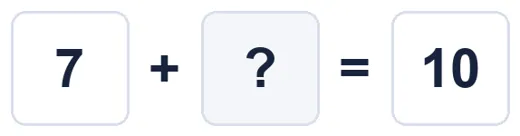
Answer: B.
- Both sides of = show the same amount.
- Think: which number goes with 7 to make 10? 10 − 7 = 3. Check: 7 + 3 = 10.
Show answer
Answer: B. Both sides of = show the same amount. Think: which number goes with 7 to make 10? 10 − 7 = 3. Check: 7 + 3 = 10.
Which answer completes the pattern?
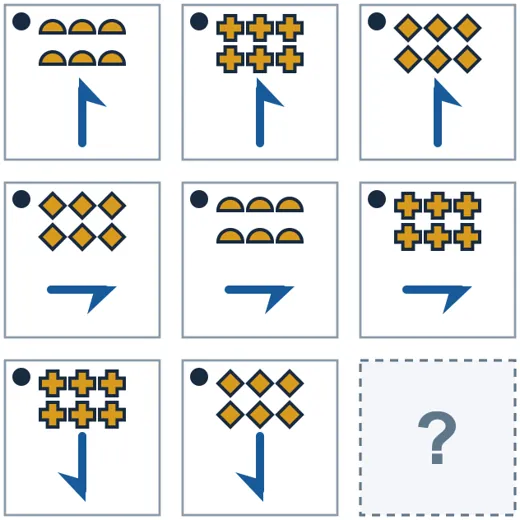
Answer: A.
- Check each row and each column.
- Every row and every column has each kind of small shape once; the direction of the hook stays the same along each row.
- For the kind of small shape, the missing picture takes the one that its row and its column do not have yet.
Show answer
Answer: A. Check each row and each column. Every row and every column has each kind of small shape once; the direction of the hook stays the same along each row. For the kind of small shape, the missing picture takes the one that its row and its column do not have yet.
Grades 3 to 5: four sample questions
Which picture does not belong?
Answer: D.
- Count the objects on each side of the line.
- Five pictures show more objects on one side of the line than the other. The picture with the pear has 3 on each side.
Show answer
Answer: D. Count the objects on each side of the line. Five pictures show more objects on one side of the line than the other. The picture with the pear has 3 on each side.
Which answer completes the pattern?
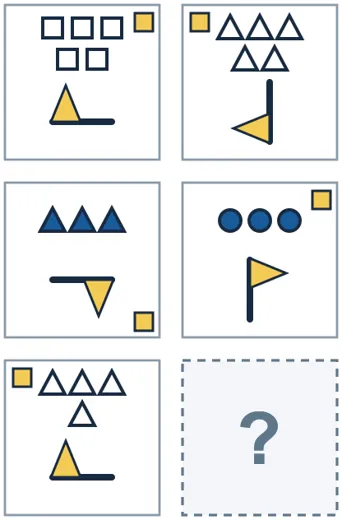
Answer: B.
- Compare the two pictures in each of the first two rows: the same change happens in both.
- The change: change the small shapes in the order circle → square → triangle → circle, move the mark one corner counterclockwise and turn the flag a quarter turn counterclockwise. Do the same to the third picture.
Show answer
Answer: B. Compare the two pictures in each of the first two rows: the same change happens in both. The change: change the small shapes in the order circle → square → triangle → circle, move the mark one corner counterclockwise and turn the flag a quarter turn counterclockwise. Do the same to the third picture.
Which answer completes the pattern?

Answer: C.
- Look at how each number changes into the next one.
- Each step is double the one before (+ 1, + 2, + 4, + 8, + 16), so the next step is + 32: 43 + 32 = 75.
Show answer
Answer: C. Look at how each number changes into the next one. Each step is double the one before (+ 1, + 2, + 4, + 8, + 16), so the next step is + 32: 43 + 32 = 75.
Which answer completes the pattern?
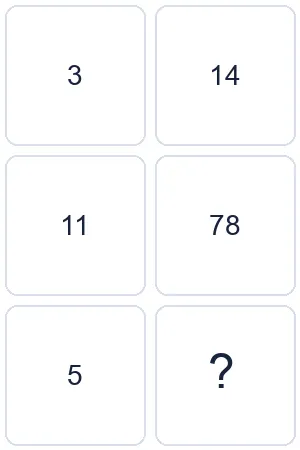
Answer: D.
- Find one rule that turns the first number into the second in both example rows.
- The rule is: multiply by 8, then subtract 10. Check: 8 × 3 − 10 = 14 and 8 × 11 − 10 = 78.
- So 8 × 5 − 10 = 30.
Show answer
Answer: D. Find one rule that turns the first number into the second in both example rows. The rule is: multiply by 8, then subtract 10. Check: 8 × 3 − 10 = 14 and 8 × 11 − 10 = 78. So 8 × 5 − 10 = 30.
What does each NGAT question family test?
The Naglieri General Ability Tests are three separate tests, each 40 questions long. MHS describes them as measures of general ability that use pictures, shapes and numbers rather than reading. The sample items above follow the same split.
Verbal: the shared idea
Six pictures, five of which belong to one concept. Questions 1 and 5 show the two kinds of concept a child meets: what things are used for (food tools versus a wheel) and a property you can count or see, such as more objects on one side of a line.
Nonverbal: the shape rule
A matrix of figures that change across rows and down columns. Questions 2, 4 and 6 practice the three habits that matter: compare the first two rows, name every change (number, turn, position), then apply all of them to the last cell.
Quantitative: the number relationship
Numbers in grids, sequences and short equations. The arithmetic stays simple; the work is noticing the relationship. Question 3 is a missing addend, question 7 a doubling step pattern, question 8 a two-step rule (multiply, then subtract).
A wrong choice on these items is rarely random. Most distractors fit part of the rule: the flag turned but the shape count did not change, or the number grew by the right amount once but not twice. That is why the explanation for every choice says which part of the rule it misses.
How do you coach without giving the answer away?
- Ask for the rule first. “What changes from the first picture to the second?” A child who can say the rule has done the reasoning; the answer follows.
- Make them check every option. On matrix items, have your child say why each choice fails before picking the last one standing.
- Count, do not guess. On questions 2 and 5 the difference is a number of objects. Pointing and counting is allowed and helps.
- Praise the explanation, not the score. If a child gets one wrong but can explain the rule afterwards, that is the outcome you want before test day.
- Stop while it is still fun. Ten minutes a day beats one long session. The real tests run up to half an hour each, so build attention gradually.
Practice, not an official score
Eight questions cannot estimate a standard score, percentile or stanine, and these items are not normed. Use them to find out whether the three formats feel familiar. Your district decides which NGAT tests it gives, in which grades, and how the result is combined with other evidence, so ask the school for its own identification steps.
NGAT Test Prep is made by Neobile LLC and is independent of MHS and of the test authors; the questions on this page are its own original items.
Sources
Questions people ask
Are these real NGAT questions?
No. MHS does not publish its test items. These eight questions are original practice items from the NGAT Test Prep question bank, written to show the three formats MHS describes: pictures that share a concept, shape matrices, and number relationships.
How many questions are on the real NGAT?
MHS lists 40 questions per test, one per screen, with a maximum of 30 minutes per test in kindergarten through grade 2 and 35 minutes in grades 3 through 9. A district may give one, two or all three tests.
Which sample questions should a kindergartner try?
Start with the first four, marked kindergarten to grade 2. The grades 3–5 questions use longer number patterns and changes with more parts, which most younger children find frustrating.
Does a score on these questions predict the NGAT result?
No. Eight practice questions say nothing reliable about a national percentile. They show whether the format makes sense to your child, which is the only goal of practice before an ability test.
Can my child practice in Spanish?
In the NGAT Test Prep app, instructions and explanations are available in Spanish as well as English. On the real test, MHS presents the directions through animated videos so children do not have to follow spoken instructions.