Verbal, Nonverbal, and Quantitative, explained for parents
What is the NGAT test? A parent guide to the Naglieri General Ability Tests
The NGAT (Naglieri General Ability Tests) is three online ability tests from MHS that districts use in gifted screening for kindergarten through grade 9. Verbal uses pictures sharing an idea, Nonverbal uses shape grids and Quantitative uses number relationships. Each test has 40 questions and a 30- or 35-minute limit.
Your school chooses which tests, grades, and dates it uses, and how results are combined with other information. Confirm the details with your school before you plan any practice.
Verbal, nonverbal, and quantitative practice for K–5
01 / Start with the basics
What is the NGAT?
NGAT is the short name parents and schools often use for the Naglieri General Ability Tests, published by Multi-Health Systems Inc. (MHS). The suite has three separate tests, Naglieri–Verbal, Naglieri–Nonverbal, and Naglieri–Quantitative, which a district can give on their own or in any combination. MHS describes the tests as intended for kindergarten through grade 9.
The NGAT is an ability test, not an achievement test. Instead of asking what a child has already learned in class, it looks at how the child reasons through unfamiliar problems. MHS says the tests are designed to measure general ability in a way that minimizes the influence of culture, language, economic background, and academic knowledge. That is why the questions rely on pictures, shapes, and simple numbers, and why the directions are shown through short animated videos rather than long spoken instructions.
Districts use the NGAT in different ways. Some give all three tests to every student in a grade as a universal screener, then look more closely at students who show potential. Others give only one test, such as the Nonverbal test, in selected grades. In either case the NGAT is usually one step in a larger identification process, not the only piece of information a school considers.
Test structure and design goals come from the publisher’s Naglieri General Ability Tests overview and the frequently asked questions on the official NGAT information site.
02 / Pictures, shapes, and numbers
The three NGAT tests and what their questions look like
Each test measures general ability through a different kind of content. The examples below are original and only illustrate the kind of thinking involved. They are not actual test content, and the publisher does not release its own list of question subtypes, so the “In the app” notes describe how NGAT Test Prep organizes its practice.
Naglieri–Verbal: find the shared idea
The Verbal test asks a child to recognize a verbal concept when it is shown through pictures rather than words. The official NGAT information site describes questions with six pictures in which five share a concept, so the child looks for the idea that connects most of the pictures and the one picture that does not fit.
Original example
A spoon, a fork, a bowl, a cup, a plate, and a shoe. Five are used for eating or drinking, so the shoe does not belong. Harder versions depend on how objects are used, what state they are in, or how they relate to each other.
In the app
Verbal practice asks, “Which picture does not belong?” and covers three skills: Category & function, Attributes & states, and Picture relationships.
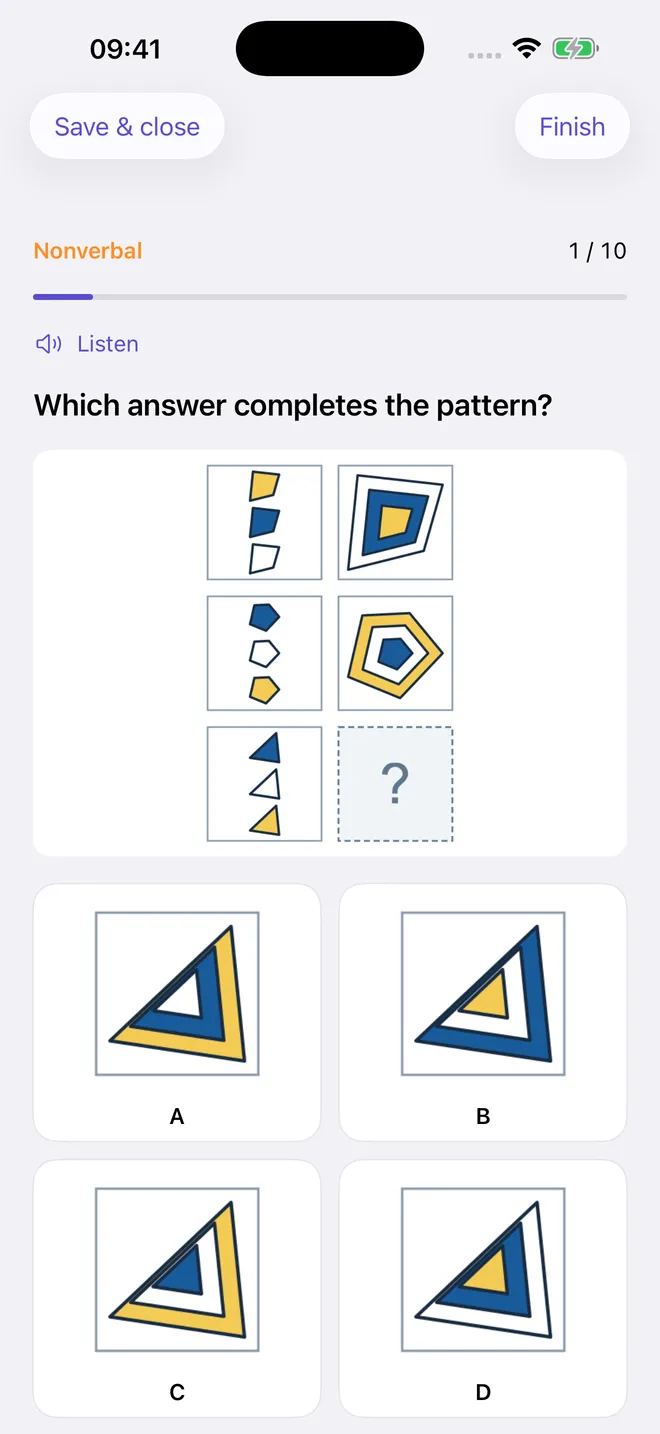
Naglieri–Nonverbal: discover the shape rule
The Nonverbal test uses matrix-based items built from shapes. A child studies how the figures change across rows and down columns, including sequences, spatial orientation, and other details, then chooses the figure that completes the design.
Original example
In each row, a small triangle, then a medium triangle, then a large triangle, with the shading moving one step each time. The missing cell must continue both the size change and the shading change.
In the app
Nonverbal practice asks, “Which answer completes the pattern?” and covers Analogical changes, Row & column patterns, and Spatial relationships.
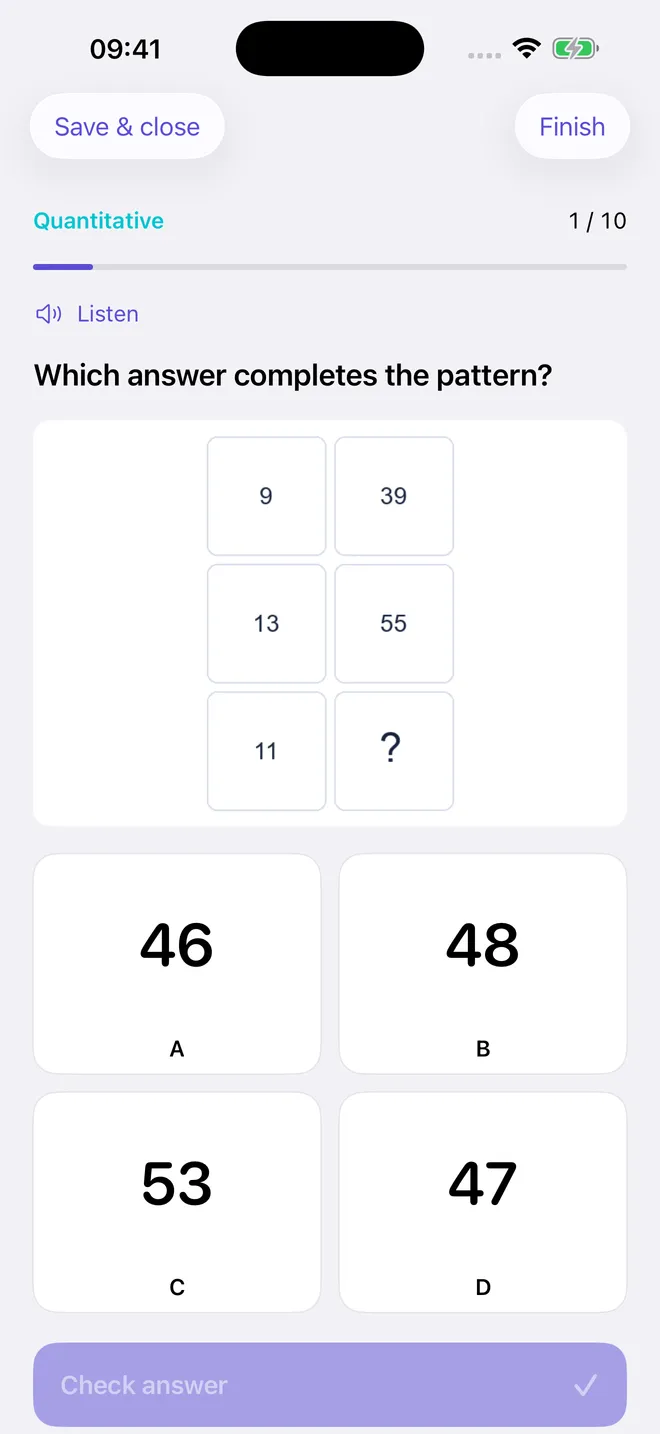
Naglieri–Quantitative: connect the numbers
The Quantitative test looks at relationships among numbers and symbols using basic math concepts. The arithmetic itself is kept simple; the challenge is noticing the relationship that links the numbers.
Original example
The pairs 2 → 4, 3 → 6, and 5 → 10 follow one rule, so 6 → 12. A sequence such as 3, 5, 7, 9 continues with 11. A short number sentence such as ? + 4 = 10 can also hide a missing number.
In the app
Quantitative practice covers Number relationships, Number sequences, and Visual equations, with numbers shown in grids and simple number sentences.
Across all three tests, many wrong choices fit part of the rule. The habit that helps most is naming the complete rule, then checking every answer choice against it before choosing.
03 / What happens on test day
How the NGAT is given and scored
The NGAT is administered and scored online. Students can test on a desktop computer, laptop, Chromebook, or a tablet held in landscape orientation. Before each test begins, a staff member logs students in, an instructional video shows how to answer, and every student completes three practice questions.
40 questions per test
Questions appear one per screen. MHS lists the same 40-question length for Verbal, Nonverbal, and Quantitative.
30 or 35 minutes per test
The maximum is 30 minutes per test in kindergarten through grade 2 and 35 minutes in grades 3 through 9, plus a few minutes of setup.
Small groups for the youngest
MHS recommends small groups or one-on-one testing for kindergarten and grade 1 and allows larger groups in higher grades.
Standard scores and percentiles
Reports include standard scores, percentiles, and stanines. When two or more tests are given, a combined score is also available.
Scores can be compared with national or local norms, and MHS offers individual reports in English and Spanish. What happens next is a district decision: the score that leads to further review, the other evidence a school collects, and the services a child may receive all vary. Ask your school for its identification steps in writing rather than relying on numbers shared online.
Administration details come from the MHS Help Center page Administer the test and the MHS product listing.
04 / Similar names, different tests
NGAT vs. NNAT, CogAT, and OLSAT
Gifted testing uses several similar-sounding tests, and a district may switch from one to another. Knowing which one your child will take matters, because the question formats are different.
Three separate tests
Verbal pictures, Nonverbal shape matrices, and Quantitative number relationships, given online, one test or several.
One nonverbal test
Also developed by Jack Naglieri. It uses figure reasoning only; the NGAT Nonverbal test is the closest match. See NNAT question types.
Three batteries, nine subtests
Verbal, quantitative, and nonverbal batteries, each with three distinct subtests. See CogAT question types.
Verbal and nonverbal areas
At the K–2 levels, listening-based verbal questions plus picture and shape questions. See OLSAT question types.
If your child has practiced for the NNAT, the NGAT Nonverbal test will look familiar, but the Verbal and Quantitative tests are new formats. The NGAT Verbal test is also different from verbal sections that ask a child to read words or listen to sentences: here, the concept is carried by the pictures themselves.
05 / A calm approach
How to help your child feel ready without drilling
The NGAT is designed to show how a child reasons with problems they have not seen before, so the aim is not to memorize questions. Understanding the format helps you answer your child’s questions, makes the test feel familiar, and keeps test day low-key.
Aim for familiarity and focus rather than volume. The official site’s own test-taking tips are simple: look at each question carefully, expect later questions to be harder, know that only one answer is correct, and remove choices that clearly do not fit.
Look at every part
Before choosing, check all pictures, every cell of a grid, or every number pair. Rushed answers often fit only part of the rule.
Say the rule out loud
“Five of these are used for eating.” “Each row gets bigger.” A rule your child can explain is reasoning, not guessing.
Remove what does not fit
Cross out choices that break one part of the rule, then compare what is left.
Build steady attention
Each test can last up to about half an hour. Short, regular sessions help a child stay settled for that long.
- Confirm which tests your child will take
Ask whether the school gives Verbal, Nonverbal, Quantitative, or all three, and in which month.
- Try each format once or twice
A few picture, shape, and number questions are enough to make the directions familiar. Stop while your child is still interested.
- Talk about mistakes kindly
Ask what your child noticed first, then look at the rule together. The goal is a clearer way of thinking, not a higher count of correct answers.
- Keep the last days normal
Protect sleep, keep routines, and describe the test as a set of puzzles. Confidence matters more than one more session.
Preparation cannot promise a score or a program decision. The National Association for Gifted Children encourages using multiple measures rather than a single test. For questions to ask your school, see the advanced learning program guide.
A focused K–5 practice tool
Practice picture, shape, and number reasoning in NGAT Test Prep
NGAT Test Prep follows the three NGAT areas with separate practice for Verbal, Nonverbal, and Quantitative reasoning, each divided into three skills. Choose your child’s grade from kindergarten through grade 5, pick an area, and work through a short session. A Listen button reads the question prompt aloud, and question pictures can be enlarged.
After each practice answer, numbered steps explain the rule, and a missed choice includes a short reason it does not fit. For format familiarity, the app also offers 40-question area rehearsals with optional 30- or 35-minute timers that match the grade band, a short mixed session, mistake review, and a parent report of first attempts by skill.
- Kindergarten through grade 5
- Verbal, Nonverbal, and Quantitative practice
- Worked explanations and answer review
- Free practice questions each day
- English or Spanish interface and explanations
- iPhone and iPad; works offline
Verbal, nonverbal, and quantitative practice for K–5

No account and no ads. Up to three learner profiles and their progress stay on the device.
06 / Related guides
Preparing for more than one test?
Many districts use more than one ability measure, or change tests from year to year. These guides explain the question formats of the other common gifted tests.
Frequently asked questions
NGAT test FAQ
What does NGAT stand for, and who publishes it?
NGAT is a common short name for the Naglieri General Ability Tests, a group of three ability tests: Verbal, Nonverbal, and Quantitative. They are published by Multi-Health Systems Inc. (MHS) and were written by Jack A. Naglieri, Dina Brulles, and Kimberly Lansdowne.
What grades take the NGAT?
MHS describes the tests as intended for students in kindergarten through grade 9. Each district decides which grades are tested and when. Some screen every child in a grade, while others test only students who are referred.
How long is the NGAT?
According to MHS, each test has 40 questions, one per screen. The maximum testing time is 30 minutes per test for kindergarten through grade 2 and 35 minutes for grades 3 through 9. Login, instructions, and three practice questions add roughly five to ten minutes to each test.
Is the NGAT the same as the NNAT?
No. Both were developed by Jack Naglieri, and the NGAT Nonverbal test uses the same kind of shape-matrix reasoning. The NNAT is a single nonverbal test published by Pearson. The NGAT adds separate Verbal and Quantitative tests and is published by MHS.
Does my child need to read or speak English to take the NGAT?
The questions use pictures, shapes, and numbers rather than reading passages, and MHS says the directions are presented through animated videos so that children do not need to understand spoken directions. The Quantitative test still uses basic number ideas. MHS also offers Spanish-language individual reports.
Should my child prepare for the NGAT?
Keep practice short and focused on understanding the format, sustaining attention, and checking every answer choice, not memorizing items. The NGAT is meant to show how a child reasons with new problems, so the goal is familiarity and calm focus, not rehearsed answers.
Is NGAT Test Prep the official NGAT app?
No. NGAT Test Prep is an independent practice app from Neobile LLC. It is not affiliated with, authorized by, or endorsed by MHS or the test authors. It uses original practice questions, and its results are not official scores or placement predictions.
Naglieri General Ability Tests™ is a trademark of its owner, and the tests are published by Multi-Health Systems Inc. (MHS). NGAT Test Prep is an independent product of Neobile LLC and is not affiliated with, authorized by, or endorsed by MHS or the test authors. Other test names belong to their respective owners. The example questions on this page are original. Practice results are not official scores, and the app does not guarantee a test score or admission to any program.