A parent guide to OLSAT Levels A, B, and C
OLSAT question types for kindergarten through second grade
At the K–2 levels, the OLSAT uses ten question types in two areas. Verbal questions focus on listening and reasoning: following directions, drawing a conclusion from a short situation, and solving number stories. Nonverbal questions use pictures and shapes: groups, analogies, sequences, and pattern grids. Kindergarten includes Picture Series; first and second grade use the other nine types.
Your school chooses the level, the format, and how results are used. Treat this as a map of the publisher’s K–2 structure and confirm the details with your school.
Listening, picture, and shape practice for K–2
01 / Start with the level
Which OLSAT level does a K–2 child take?
The Otis-Lennon School Ability Test, Eighth Edition (OLSAT 8), is published by Pearson. It is a school ability test, not an achievement test: rather than asking what a child has learned in class, it looks at reasoning tasks such as following directions, classifying, establishing a sequence, solving arithmetic problems, and completing analogies. Schools use it in different ways, including as one piece of gifted and talented or advanced learning identification.
OLSAT 8 has seven levels, A through G, that cover kindergarten through grade 12. The publisher organizes the questions into five clusters in two areas. The verbal area contains Verbal Comprehension and Verbal Reasoning. The nonverbal area contains Pictorial Reasoning, Figural Reasoning, and Quantitative Reasoning. Not every cluster appears at every level, and the youngest levels look quite different from the upper ones.
Level A: ten question types
Three listening-focused verbal types, three picture types including Picture Series, and four shape types.
Level B: nine question types
The same families as Level A without Picture Series. Expect more demanding reasoning than at Level A.
Level C: nine question types
The same nine types as Level B. Pearson lists online delivery beginning at Level C, so ask whether your child will test on paper or on a screen.
Levels D–G: a different mix
Reading-based verbal types, such as Antonyms and Sentence Completion, and Quantitative Reasoning appear from Level D. Picture questions no longer appear.
Grade labels are the publisher’s typical pairing. A school may choose a different level, test at a different time of year, or use the OLSAT alongside other measures such as the CogAT or the NNAT. Always confirm the level, form, and testing format in writing.
Question types by level come from Pearson’s OLSAT 8 overview and scope and sequence. See also the publisher’s OLSAT 8 product page.
02 / Listen, remember, reason
The three verbal question types at Levels A–C
At the K–2 levels, the verbal types focus on listening and reasoning rather than vocabulary or reading passages. They ask a child to attend to every detail, hold the important information in mind, and choose the answer that fits. The examples below are original and show the kind of thinking involved, not actual test content.
Verbal Comprehension
Understanding exactly what spoken language asks for, including small words that change the meaning.
Following Directions
The child hears an instruction and marks the matching picture. Position and size words matter: “Find the small circle that is next to the square, not inside it.” In the app: Follow the directions.
Verbal Reasoning
Using spoken information to draw a conclusion or solve a small problem.
Aural Reasoning
The child hears a short situation and chooses the picture that follows from it: “Ana’s kite is higher than Ben’s. Ben’s kite is higher than Cal’s. Whose kite is lowest?” In the app: Listen and reason.
Arithmetic Reasoning
The child hears a number story and decides whether amounts are joined, removed, or compared: “Five ducks were in a pond. Two swam away, and one came back. How many ducks are in the pond now?” In the app: Reason with numbers.
Listening questions reward patience more than speed. Many wrong answers match part of the instruction but ignore one detail, such as small, next to, or came back. Practicing with a single careful hearing, then checking every choice against every detail, builds the habit these items require.
03 / Pictures and shapes
The nonverbal question types at Levels A–C
Nonverbal questions reduce the language demand. Pictorial Reasoning uses familiar objects, so a child can use everyday knowledge about what things are and how they relate. Figural Reasoning uses abstract shapes, so the child must notice shape, size, number, position, shading, and direction.
Pictorial Reasoning
Relationships among pictures of everyday objects.
Picture Classification
Find what several pictures share, such as things that grow on trees, then choose the picture that belongs, or the one that does not. In the app: Picture groups.
Picture Analogies
Describe how two pictures connect, then use the same connection: a bird goes with a nest as a bee goes with a hive. In the app: Picture connections.
Picture Series (Level A)
Look at pictures in order and decide what comes next, such as a flower bud, a half-open flower, and then a fully open flower. In the app: Picture sequences, shown for kindergarten.
Figural Reasoning
Rules built from abstract shapes and their visual properties.
Figural Classification
Several figures share one property, such as half shaded or three sides. Find the property, then check each choice against it. In the app: Shape groups.
Figural Analogies
Name the change in the first pair, such as a small circle becomes a large circle, then make the same change to a new shape. In the app: Shape connections.
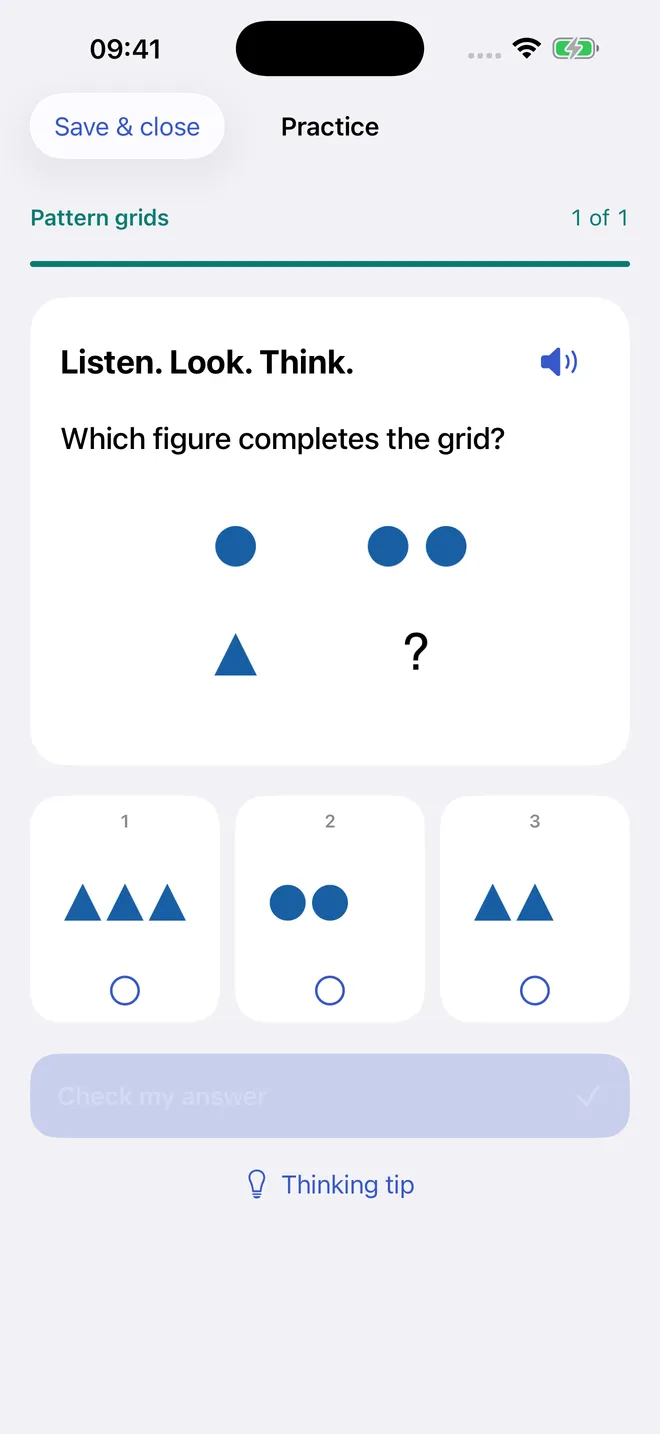
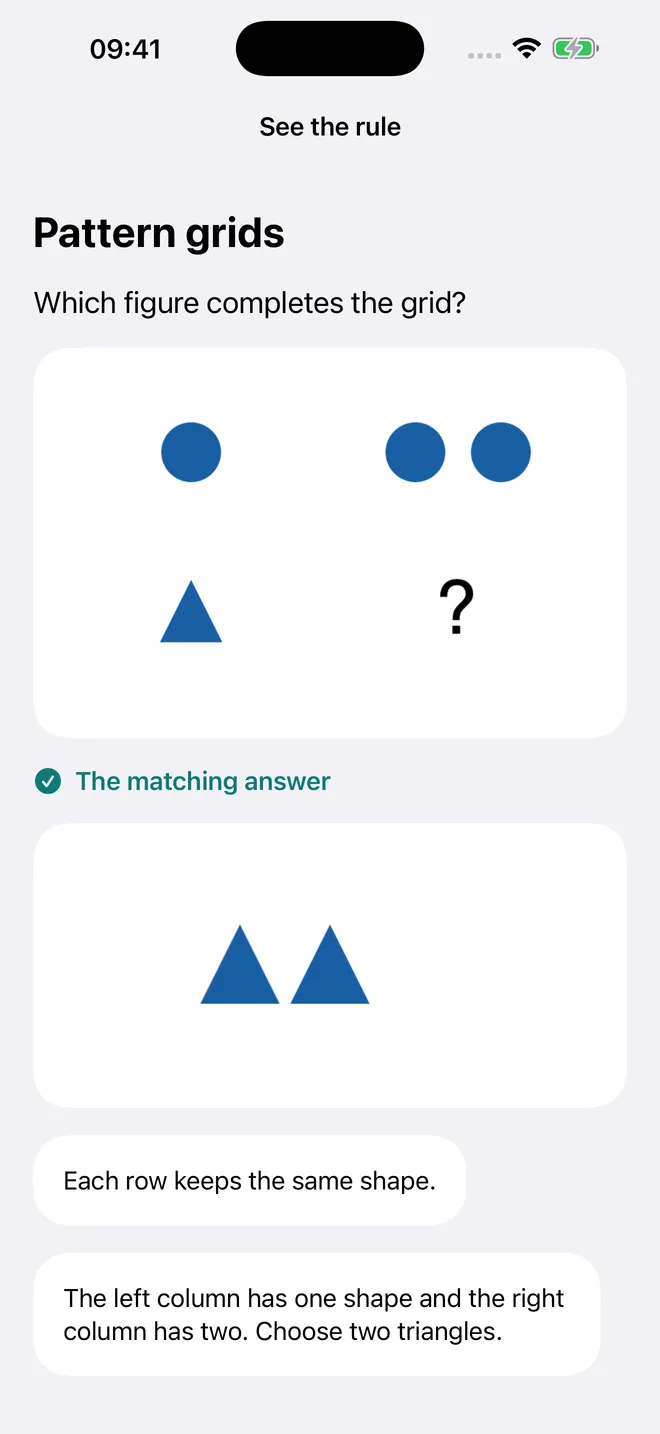
Pattern Matrix
Find the missing cell in a grid. The answer must fit both the row and the column. In the app: Pattern grids.
Figural Series
Follow figures from left to right and continue the rule, such as an arrow turning a quarter turn at each step. In the app: Shape sequences.
04 / Practice the thinking
How to practice each question type without drilling
Young children do not need a trick for every format. They need a small set of reliable habits and short sessions that end before attention runs out. Five to ten focused minutes is often plenty for a kindergartner or first grader.
Listen to the whole question
For spoken items, wait until the instruction or story is finished before looking for an answer.
Name the rule out loud
Ask, “What is the same? What changes?” A child who can say the rule is reasoning, not guessing.
Check every choice
Many wrong answers fit part of the rule. Compare each choice with every detail before choosing.
Review the reasoning
After a miss, let your child explain their first idea, then look at the rule together and try a new example later.
- Begin with one family at a time
Spend the first sessions on a single type, such as Picture Analogies, so the directions become familiar before the formats are mixed.
- Balance listening and visual work
A child who is strong with shapes may still find spoken number stories hard, and the reverse is common too. Keep both areas in the routine.
- Mix the formats later
Once each type feels familiar, short mixed sets ask the child to recognize the kind of question on their own.
- Keep the last days calm
Near test day, taper practice, protect sleep, and keep normal routines. Confidence matters more than one more session.
Preparation builds familiarity and confidence. It cannot promise a particular score or program decision. Identification practices vary, and the National Association for Gifted Children encourages using multiple measures rather than a single test. For questions to ask your school, see the advanced learning program guide.
A focused K–2 practice tool
Practice every K–2 question family in OLSAT Test Prep
OLSAT Test Prep follows the Level A–C structure with separate practice for each question family: Follow the directions, Listen and reason, Reason with numbers, Picture groups, Picture connections, Picture sequences for kindergarten, Shape groups, Shape connections, Shape sequences, and Pattern grids. An English audio button reads each question aloud, and some listening items also read the answer choices.
After each answer, numbered steps explain the rule. Missed questions return in Review until your child answers them without help in two later sessions, and a parent area shows first attempts by skill for up to three learners on the device.
- Kindergarten, Grade 1, and Grade 2
- English audio for questions
- Worked explanations and mistake review
- Free practice questions each day
- English or Spanish interface; questions in English
- iPhone and iPad
Listening, picture, and shape practice for K–2

No account and no ads. Learner nicknames and progress stay on the device.
05 / Related guides
Preparing for more than one test?
Many districts use more than one ability measure. These guides explain how the CogAT, NNAT, and NGAT compare with the OLSAT question types above.
Frequently asked questions
OLSAT question types FAQ
What question types are on the OLSAT for kindergarten?
Pearson’s OLSAT 8 scope and sequence lists ten question types at Level A, the kindergarten level: Following Directions, Aural Reasoning, Arithmetic Reasoning, Picture Classification, Picture Analogies, Picture Series, Figural Classification, Figural Analogies, Pattern Matrix, and Figural Series.
How are OLSAT Levels B and C different from Level A?
Levels B and C, commonly used in first and second grade, list the same question types as Level A except Picture Series, which appears only at Level A. Expect the reasoning to become more demanding as the level rises. Pearson lists online delivery for Levels C–G, so a second grader may test on paper or on a screen depending on the school.
Does my child need to read to take the OLSAT in K–2?
Two of the three verbal types at Levels A–C, Following Directions and Aural Reasoning, are listening tasks by design, and reading-based verbal types such as Antonyms and Sentence Completion are not listed until Level D. How much is read aloud can differ by level and format, so ask your school how directions will be given.
How is the OLSAT scored?
Pearson reports a School Ability Index along with percentile ranks and stanines, compared by age and by grade. Reports can also show separate verbal and nonverbal part scores. Each school or district decides how scores are used, and many consider other information alongside a single test.
How is the OLSAT different from the CogAT and the NNAT?
The CogAT groups reasoning into verbal, quantitative, and nonverbal batteries. The NNAT uses only nonverbal figure problems. At the K–2 levels, the OLSAT combines listening-focused verbal questions with picture and shape questions, then reports a total School Ability Index along with verbal and nonverbal part scores.
Is OLSAT Test Prep the official OLSAT app?
No. OLSAT Test Prep is an independent practice app from Neobile LLC. It is not affiliated with, authorized by, or endorsed by Pearson. It uses its own practice questions, and its results are not official scores or placement predictions.
OLSAT® is a registered trademark of Pearson Education, Inc. or its affiliates. OLSAT Test Prep is an independent product of Neobile LLC and is not affiliated with, authorized by, or endorsed by Pearson. The example questions on this page are original. Practice results are not official scores, and the app does not guarantee a test score or admission to any program.