A field guide for RBTs and SLPAs
ABA data collection methods: how to record and calculate each one
Count it, time it, score each trial, or sample it in intervals. Continuous methods (frequency and rate, duration, latency) capture every occurrence. Trial-by-trial data is scored correct or incorrect and reported as a percentage. Discontinuous methods (partial-interval, whole-interval, and momentary time sampling) record a sample of the observation in fixed intervals. Always report the count or denominator behind a number, and record exactly what your supervisor’s plan defines.
Your supervising BCBA or SLP chooses the method, the definitions, and the scoring rules. This guide explains how the methods work; it does not replace their program design, their clinical judgment, or your employer’s official data system.
No account · records encrypted on your device
01 / Two families
Continuous and discontinuous measurement
The BACB’s RBT Test Content Outline (3rd ed.), which the RBT examination follows from 2026, opens with a Data Collection and Graphing domain worth 13 of the 75 scored questions. Its first tasks ask an RBT to implement continuous measurement (for example frequency, duration, latency, and interresponse time), discontinuous measurement (partial and whole interval, momentary time sampling), and permanent product recording, then to enter data, update graphs, and calculate and summarize data as rate, mean duration, or a percentage.
Continuous
Every occurrence is recorded: how many times (frequency), how long (duration), or how soon after a cue (latency). The result is a complete record of the observation.
Trial by trial
Each learning opportunity is scored correct or incorrect under the program’s rules and summarized as a percentage. This is the daily work of discrete-trial teaching and speech drills.
Discontinuous
The observation is split into equal intervals, and each interval gets one yes-or-no score. The result is an estimate, used when recording everything is not practical.
Whichever family you use, the method is not your choice to make in the moment. The operational definition says what counts as the behavior; the plan says how to measure it. An RBT’s job is to apply both the same way every session, and to tell the supervisor when the definition and what actually happens in the room stop matching.
Before you start collecting
- Read the operational definition of each target. Know what a single occurrence, the start, and the end look like.
- Check the assigned method, interval length, and trial rules for each target.
- Know how your team handles a behavior you could not see, a trial that was interrupted, and a session cut short.
- Have the data sheet or app ready before the client arrives, not after the first occurrence.
Need paper? Our free printable ABA data sheets cover every method in this guide, one page each, with the summary formula printed on the sheet.
Domain names and task wording follow the BACB’s RBT Test Content Outline (3rd ed.), updated 09/2024.
02 / Frequency and rate
Frequency: count every occurrence, then turn it into a rate
Frequency recording is a tally. Each time the behavior meets its definition, it counts once. It suits behaviors with a clear start and end that do not last long, such as hand raises, requests, hits, or answers called out. It fits poorly for behaviors that run on for minutes, like crying or staying in a seat; duration or interval methods work better there.
A raw count depends on how long you watched, so it is usually reported as a rate: count divided by observation time.
Session A: 7 hand raises in a 10-minute observation7 ÷ 10 = 0.7 per minute
Session B: 12 hand raises in a 20-minute observation12 ÷ 20 = 0.6 per minute
Which session had more?B has the higher count, A the higher rate
Divide by the whole time you were observing, not by the gap between the first and last occurrence. If the client leaves the room for five minutes and you cannot observe, follow your team’s rule for that time; many plans subtract it from the observation time and ask you to note why.
03 / Duration
Duration: time each bout from onset to offset
Duration recording measures how long the behavior lasts. Start the timer at the onset the definition describes and stop it at the offset. When the behavior happens several times, each one is a separate bout, and the plan may ask for the total, the mean per bout, or the percentage of the session.
Three bouts of on-task work: 40 s, 1 min 15 s, 25 sTotal 140 s (2 min 20 s)
Mean duration per bout140 ÷ 3 = 46.7 s
Share of a 10-minute (600 s) observation140 ÷ 600 = 23.3%
The classic duration error is a timer left running. If you realize you forgot to stop it, do not guess a new number silently: correct it the way your team documents corrections and add a short note. The second classic error is deciding onset and offset by feel; if the definition says the bout ends after 3 seconds of no crying, wait the 3 seconds.
04 / Latency
Latency: time from the cue to the response
Latency is the time between a cue, such as an instruction, and the start of the response. It is useful when the question is not whether the client responds but how quickly, for example following a transition instruction. Start timing when the cue is delivered, stop when the response begins, and repeat for each cue.
Four cues answered after 4 s, 7 s, 3 s, and 10 sMean 24 ÷ 4 = 6 s
A fifth cue with no response before the next instructionReported separately, per the plan
Do not enter a made-up time for a cue that got no response, and do not quietly drop it either. Plans handle it differently (some cap the time, some count it as a separate outcome), so ask how yours wants it recorded. Interresponse time, the time between two responses, is measured the same way, from the end of one response to the start of the next.
05 / Percent correct
Trial-by-trial data and percent correct
For skill targets, each learning opportunity is a trial, and each trial is scored correct or incorrect under the program’s rules. The summary is a percentage: correct trials divided by total trials, multiplied by 100.
/r/ in initial position: 16 correct of 20 trials16 ÷ 20 × 100 = 80%
Another target: 4 correct of 5 trials4 ÷ 5 × 100 = 80%
Zero trials presentedNo data, not 0%
Both targets show 80%, but 4 of 5 rests on far fewer trials than 16 of 20, so write the fraction next to the percentage. A session with no opportunities is “no data”; recording it as 0% would suggest the client got every trial wrong.
Many ABA and speech programs score more than correct or incorrect: the prompt level used, whether a response was independent, or the cueing an SLP set. If your program uses a prompt hierarchy, score exactly the categories on your data sheet. The same logic applies to speech-language pathology assistants. ASHA’s SLPA Scope of Practice lists “collecting data and calculating percentages for the SLP to use” and preparing charts, records, and graphs as SLPA responsibilities, and places interpreting results and modifying the plan of care with the supervising SLP. For oral reading fluency and running records, which use their own formulas, see our guide to calculating WCPM and reading accuracy.
SLPA responsibilities are quoted from ASHA’s Speech-Language Pathology Assistant Scope of Practice (2022).
06 / Interval recording
Whole-interval, partial-interval, and momentary time sampling
Interval methods divide the observation into equal intervals, for example twenty 30-second intervals in 10 minutes, and give each interval one score. The three methods differ only in the rule for scoring “yes.”
Whole interval
Score yes only if the behavior occurred for the whole interval. Tends to underestimate how much the behavior happened; often used for behaviors a plan aims to increase, such as on-task work.
Partial interval
Score yes if the behavior occurred at any point in the interval, even once. Tends to overestimate; often used for behaviors a plan aims to decrease.
Momentary time sampling
Look at the moment the interval ends and score only what is happening then. Errs in both directions and misses what happens between samples.
These biases are measured, not folklore. Powell, Martindale, and Kulp (1975) compared the three methods with a continuous record of in-seat behavior: whole-interval sampling consistently underestimated it, partial-interval sampling consistently overestimated it, and momentary samples missed high and low about equally often. The more often samples were taken, the closer every method came to the continuous record.
The summary is the percentage of intervals scored yes. The detail that trips people up is the interval you could not score because you were blocking, prompting, or looking away.
20 partial intervals: 9 yes, 9 no, 2 not observed9 ÷ 18 = 50% of scored intervals
Same data if the 2 unobserved intervals are scored “no”9 ÷ 20 = 45%, lower than the data shows
What to report9 of 18 scored (50%), 2 unscored
Whether unobserved intervals are excluded, repeated, or handled another way is your supervisor’s rule. What matters is that you never fill them in from memory and that the count of unscored intervals appears next to the percentage. For momentary time sampling, score at the sample moment itself; a look two seconds late is a different sample.
Bias findings: Powell, J., Martindale, A., & Kulp, S. (1975). An evaluation of time-sample measures of behavior. Journal of Applied Behavior Analysis, 8(4), 463–469.
07 / Recording errors
Common data collection errors and how to avoid them
The Test Content Outline asks RBTs to describe the risks of unreliable data collection and poor procedural fidelity. A supervisor can only make good decisions from data that reflects what happened. These are the errors that most often creep in during a busy session:
- Recording from memory after the session
Counts made at the end of a session drift toward what you expected to see. Record each occurrence, trial, or interval as it happens.
- Definition drift
Over weeks, “a hit” can quietly start to include a touch. Reread definitions regularly and ask when an occurrence does not clearly fit.
- Timers left running or never started
Check that every duration and latency timer is in the state you think it is before you look away, and stop open timers before ending the session.
- Guessing missed intervals
An interval you did not observe is unscored, not “probably no.” Report how many there were.
- Percentages without denominators
80% of 5 and 80% of 20 are not the same evidence. Always keep the count behind the percentage, and record “no data” rather than 0% when there were no opportunities.
- Silent corrections
If you tapped twice or scored the wrong target, correct it in the way your team documents corrections so the record shows a change was made.
- Missing context
The outline also asks RBTs to report variables that might affect progress, such as illness, medication, or schedule changes. A one-line objective session note gives your supervisor that context.
08 / Privacy
Keep client information to the minimum
Session data is confidential client information. The Test Content Outline expects RBTs to identify and comply with requirements for collecting, using, storing, protecting, and disclosing confidential information, and ASHA’s SLPA Scope of Practice lists compliance with HIPAA and FERPA among an SLPA’s responsibilities and bars sharing confidential information with anyone the SLP has not approved. In practice, your employer’s policy decides where data may be recorded, and its official system is usually where the record belongs.
A privacy routine for field data
- Follow your employer’s policy on which devices and apps may hold session data. If the answer is “only ours,” use only theirs.
- Use an internal client code or initials instead of a name, and leave out birth dates, addresses, and diagnoses.
- Keep session notes objective and short: what happened, not your interpretation of it.
- Lock the device, and do not leave data open on screen where caregivers, other clients, or the public can see it.
- Transfer data to the official system as your employer requires, then delete copies you no longer need.
A code or initials limits what a lost phone or a misdirected file reveals, but it does not make the record anonymous. HHS guidance on HIPAA de-identification says a data set containing patient initials does not meet the Safe Harbor method, and session dates are identifying details too. Treat a coded record as confidential client information.
De-identification guidance: HHS, Guidance Regarding Methods for De-identification of Protected Health Information (archived copy of 2026-08-25). Confidentiality task F.5: BACB RBT Test Content Outline (3rd ed.). SLPA duties: ASHA SLPA Scope of Practice.
When a clipboard slows you down
Take the same data with ABA Data Collection: RBT & SLP
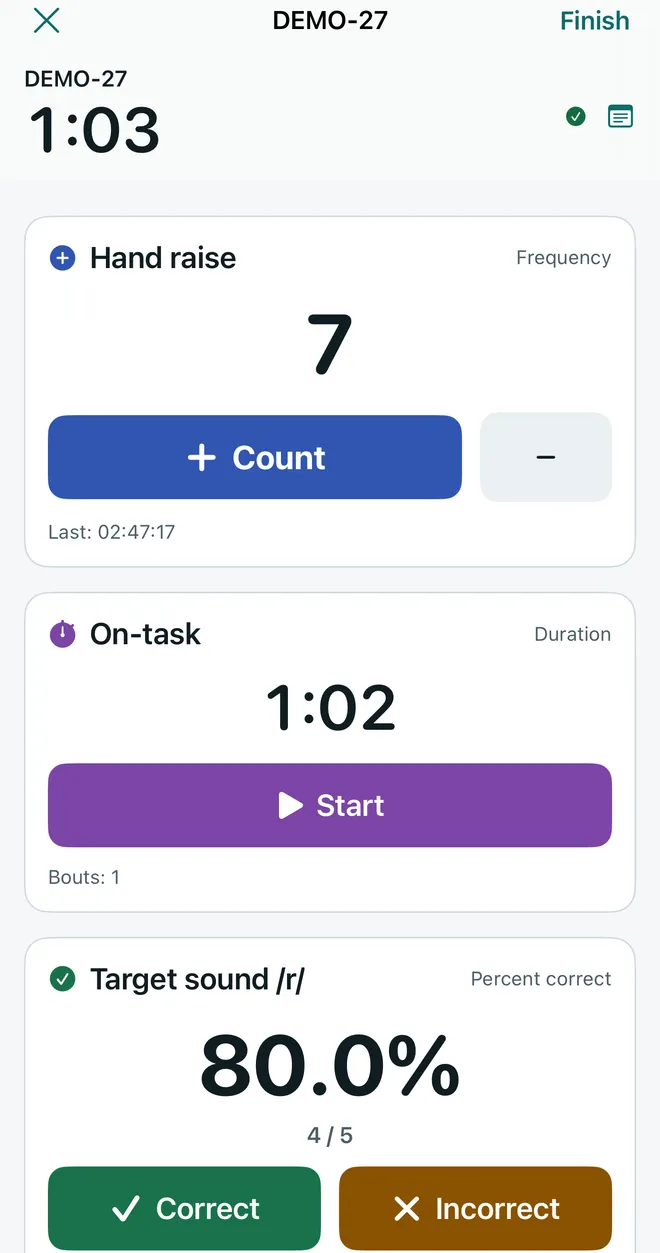
ABA Data Collection: RBT & SLP is a field tool for recording the methods in this guide on iPhone or iPad. Set up a session with an optional client code or initials (the app asks you not to use names, birth dates, or addresses), add up to 24 targets, and choose a method for each: frequency, duration, latency, percent correct, whole interval, partial interval, or momentary time sampling. Every card has large buttons, so a count, a start and stop, or a correct/incorrect score is one tap while your attention stays on the client.
Frequency taps are time-stamped. Duration records multiple start/stop bouts. Latency times each cue to the response, averages only completed trials, and lists a cue still waiting for a response when the session ends as incomplete instead of counting it. All interval targets share one cadence (5 seconds to 60 minutes) with a countdown; partial interval can be marked the moment the behavior occurs, and a momentary sample scored more than 5 seconds after the sample moment is flagged as late. Intervals left unanswered, including any that pass while the app is in the background, are marked unscored and left out of the denominator, and the count is shown. There is an undo for the last action, a session note, and automatic recovery of an active session if the app is interrupted.
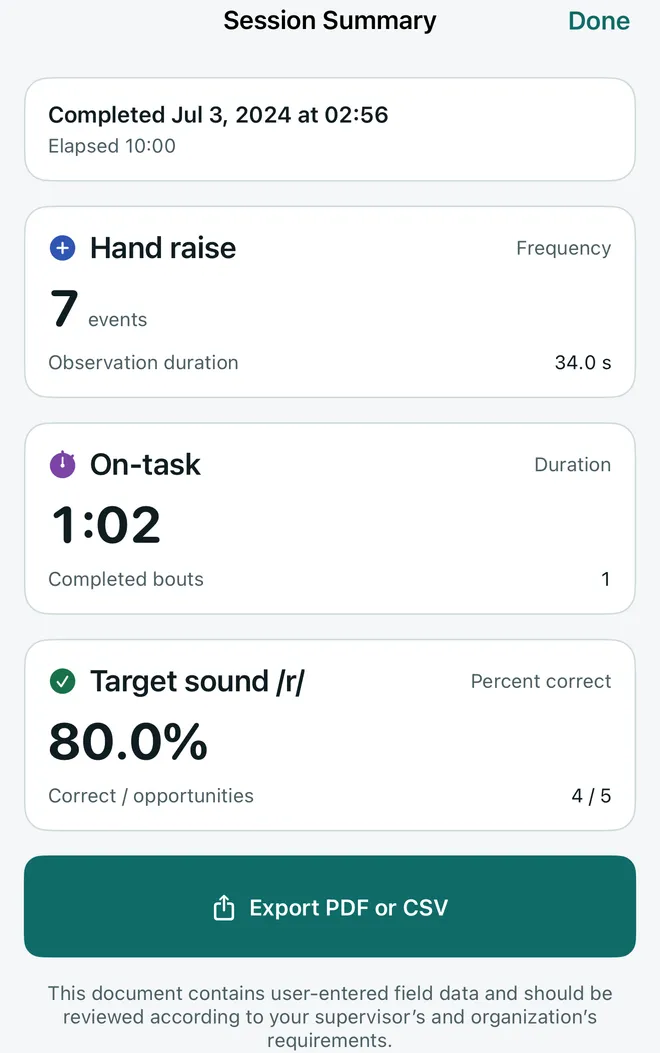
The summary shows each target’s result with its numerator and denominator, unscored intervals, and the number of corrections. For frequency it shows the count and the time between the first and last tap, so to report a rate, divide by the elapsed session time. Export a single session as a PDF or as a CSV with the summary and time-stamped raw observations. A privacy-safe mode, on by default for every export, leaves out the client code and note and replaces target labels with numbers; session dates remain. Then send the numbers wherever your employer’s system requires them. Prefer a clipboard for some sessions? The printable data sheets use the same summary rules as the app.
Records are encrypted, stored only on the device, and excluded from device backup. There is no account, no cloud sync, no ads, and no analytics; the app lock uses Face ID, Touch ID, or the device passcode, and the screen is hidden in the app switcher and while it is being recorded or mirrored. Because nothing syncs, deleting the app deletes its records. Neobile does not describe the app as HIPAA compliant; whether you may use it is your employer’s call.
Version 1.1 adds client progress: a chart of each client’s results across the sessions you recorded, and one PDF or CSV progress report per client for the last 7 days, the last 30 days, or all sessions, with your name and organization on it. Client setups save a client’s targets and interval cadence so the next session starts in one tap.
The app records what you enter and calculates descriptive summaries; its charts show only the values you recorded. It does not score prompt levels, diagnose, interpret, recommend, or establish mastery, and it notes that its terminology has not yet been reviewed by a practicing RBT or SLPA, so check its definitions against your supervisor’s. Every measurement method, session history, the session summary, the app lock, and single-session export work without a purchase; an optional in-app purchase adds client setups, progress charts and reports for your own clients, and your name and organization on reports. A sample client shows the charts and the report before you decide.
- For iPhone and iPad · iOS 17.0 or later
- Seven measurement methods, up to 24 targets per session
- Numerator and denominator on every percentage
- Single-session PDF and CSV export; per-client progress reports
- Encrypted on device, no account or cloud sync
- English and Spanish
No account · records encrypted on your device

Your observations, encrypted on your iPhone or iPad.
Frequently asked questions
ABA and SLPA data collection FAQ
What are the main ABA data collection methods?
The BACB’s RBT Test Content Outline (3rd ed.) groups them into continuous measurement (frequency, duration, latency, and interresponse time, summarized as rate, mean duration, or a percentage), discontinuous measurement (partial-interval, whole-interval, and momentary time sampling), and permanent product recording. Trial-by-trial data, scored correct or incorrect and reported as a percentage, is the everyday method for skill targets taught in discrete trials.
What is the difference between continuous and discontinuous measurement?
Continuous measurement records every instance of the behavior during the observation: every occurrence, every second it lasts, or every cue-to-response delay. Discontinuous measurement divides the observation into intervals and records only whether the behavior met a rule in each one, so it produces a sample and an estimate rather than a complete record. It is used when counting or timing everything is not practical.
How do you calculate rate in ABA?
Divide the count by the length of the observation. Seven hand raises in a 10-minute observation is 7 ÷ 10 = 0.7 per minute. Rate lets you compare sessions of different lengths: 12 hand raises in a 20-minute session is 0.6 per minute, a lower rate even though the count is higher. Use the full observation time, not the time between the first and last occurrence.
Is partial-interval or whole-interval recording more accurate?
Neither is exact. In Powell, Martindale, and Kulp’s 1975 study in the Journal of Applied Behavior Analysis, whole-interval sampling consistently underestimated the continuous measure and partial-interval sampling consistently overestimated it, while momentary time sampling erred in both directions about equally often. Shorter intervals brought all three closer to the continuous record. Your supervisor picks the method and interval length with those biases in mind.
How do SLPAs take data and calculate percent accuracy?
ASHA’s SLPA Scope of Practice lists documenting performance, “collecting data and calculating percentages for the SLP to use,” as an SLPA responsibility, alongside preparing charts, records, and graphs. For each trial the SLP’s plan defines, score correct or incorrect, then divide correct by total trials and multiply by 100: 16 correct of 20 trials is 80%. Report the count with the percentage and leave interpretation and plan changes to the SLP.
Can an RBT choose which data collection method to use?
No. The supervising BCBA or BCaBA designs the measurement system: the operational definition, the method, the interval length, and the scoring rules. The RBT implements it accurately, and the Test Content Outline asks RBTs to seek clinical direction from a supervisor in a timely manner, for example about data irregularities. If a method does not fit what you see in session, record what the plan asks for and raise it with your supervisor.
Can I take session data on my own phone?
Only if your employer allows it. Many agencies and schools require data to go straight into their own system, and some prohibit client information on personal devices. If a separate device is allowed, record the minimum: an initials or a code instead of a name, and no birth dates or addresses. HHS guidance notes that initials do not meet the HIPAA Safe Harbor standard for de-identification, so treat even a coded record as confidential.
Is ABA Data Collection: RBT & SLP HIPAA compliant?
Neobile does not describe the app as HIPAA compliant, and no app makes you compliant on its own. What it does: records are encrypted and stored only on the device, excluded from device backup, never sent to a Neobile server, and optionally protected by Face ID, Touch ID, or the device passcode. There is no account and no cloud sync. Whether you may use it is your employer’s decision, and exported files are yours to protect.
ABA Data Collection: RBT & SLP is an independent product of Neobile LLC. It is not affiliated with, endorsed by, or certified by the Behavior Analyst Certification Board (BACB) or the American Speech-Language-Hearing Association (ASHA). RBT® and Registered Behavior Technician™ are marks of the BACB. This guide is general education, not clinical or legal advice. The app records the observations you enter; it does not diagnose, interpret, recommend treatment, or establish mastery, and it is not a practice-management system or electronic health record. Use it only under your supervisor’s direction and as your organization permits. iPhone, iPad, and Face ID are trademarks of Apple Inc.